
By Assaf Morag, Cybersecurity Researcher
Haute couture is presented as the most controlled, exclusive, and artisanal corner of the fashion industry. Invitation-only shows. One-of-one garments. Months of handwork. Astronomical prices.
But when you step away from the runway narrative and look at couture as a system (materials, labor, knowledge, logistics, and incentives), a different picture emerges. Now, couture is not only a product, but it is also an economy. And like all high-value economies, it has an underground layer.
We see a lot of ads that sell haute couture fashion in the underground, so this time we stopped to take a second look. Fake merchandise is something as old as legitimate markets themselves. In the underground economy, clothing is normally considered a brighter side of the black market and thus doesn’t receive much attention in the media. Furthermore, the victims are the brands themselves and not the general public, so it may be harder to perceive brands that charge tens of thousands of dollars as innocent victims. But this is a deeper story about an industry, its byproducts, and its internal economic logic.
Key Takeaways About the Cybercrime Fashion Economy
- Luxury goods are an effective money laundering vehicle: Cryptocurrency payments, geographic dispersion, and high-value resale margins make haute couture a surprisingly efficient pipeline for converting illicit capital into legitimate assets.
- The counterfeit market is a spectrum, not a binary: Fake couture ranges from transparent replicas to near-undetectable fakes priced close to retail, reflecting a parallel economy built on trust, perception, and narrative rather than legality.
- Weak technical protections make couture uniquely vulnerable: Unlike pharmaceuticals or software, couture techniques cannot be meaningfully patented, making knowledge transfer through labor mobility an unavoidable structural vulnerability.
- The underground couture market is not just about bags — it’s a full economy: Clothing, machinery, household goods, and more all circulate in the same shadow markets, with luxury goods serving as the highest-profile and highest-margin segment.
- Buyers in these markets face their own risks: Scammers operate within the underground too, using deep discount offers to steal credit card details and personal information from buyers seeking counterfeit deals.
- The underground couture economy is an emergent property of the legitimate one: Wherever exclusivity, high margins, and symbolic value exist, a parallel market will inevitably form — operating under the same economic incentives, just outside legal boundaries.
Money Laundering in the Underground Fashion Economy
Many of these marketplaces advertise crypto as an optional, sometimes the only, payment method. This alone does not necessarily imply malicious intent, as there are legitimate online stores that accept cryptocurrency for privacy, international accessibility, or ideological reasons.
However, research into the underground economy consistently shows that cryptocurrency is frequently used as a mechanism for laundering illicit funds. In practice, crypto payments are often linked to proceeds originating from activities such as:
- Credit card theft and fraud
- Bank account takeovers
- Identity theft and synthetic identities
- Other forms of financial crime
In these cases, the merchandise itself may even be genuine, and sometimes priced higher than the retail original. The illegality lies not in the product, but in the financial flow – luxury goods are used as a laundering vehicle to convert dirty money into tangible, resellable assets.

A tutorial talking about techniques to launder money (Flare link to post, sign up for the free trial to access if you aren’t already a customer)
The screenshot above illustrates a common laundering pattern that can be observed in carding and fraud tutorials circulating in underground forums. In one such example, operators describe purchasing:
- 192 Hermès Birkin 25 Togo bags
- 144 Chanel Classic Flap Jumbo bags
- 120 Louis Vuitton Neverfull bags
- 96 Gucci Horsebit 1955 bags
The total transaction is paid in Monero (XMR) for approximately $100 million, with the luxury inventory resold for an estimated $280 million. The goods are then shipped across 48 different locations in Mexico, enabling geographic dispersion and resale through secondary markets.
This illustrates how luxury commerce, cryptocurrency, and logistics infrastructure converge into a highly efficient money laundering pipeline – one that operates in plain sight, using legitimate brands and real products to legitimize illicit capital.
The Counterfeit and Stolen Goods Industry
Unlike pharmaceuticals or software, couture construction methods are not meaningfully patentable. Patterns, proportions, and techniques are protected primarily by culture, reputation, and contracts – not by enforceable technical controls.
This creates the first underground market: knowledge transfer.
Artisans move between fashion houses. Subcontractors work across competing brands. Fitters, embroiderers, and tailors carry tacit knowledge that cannot be “unlearned.”
By the time a couture piece debuts publicly, its structural logic is often already understood elsewhere. This is not theft — it is an unavoidable side effect of human expertise and labor mobility.
Within this ecosystem, there are several distinct categories of “fake” in the haute couture forgery industry.
Some sellers are explicit in selling fake items that look real. Others knowingly sell counterfeits by claiming that they are real.
In some cases, the merchandise is significantly cheaper; in others, it is priced close to the original, exploiting perceived authenticity rather than affordability.
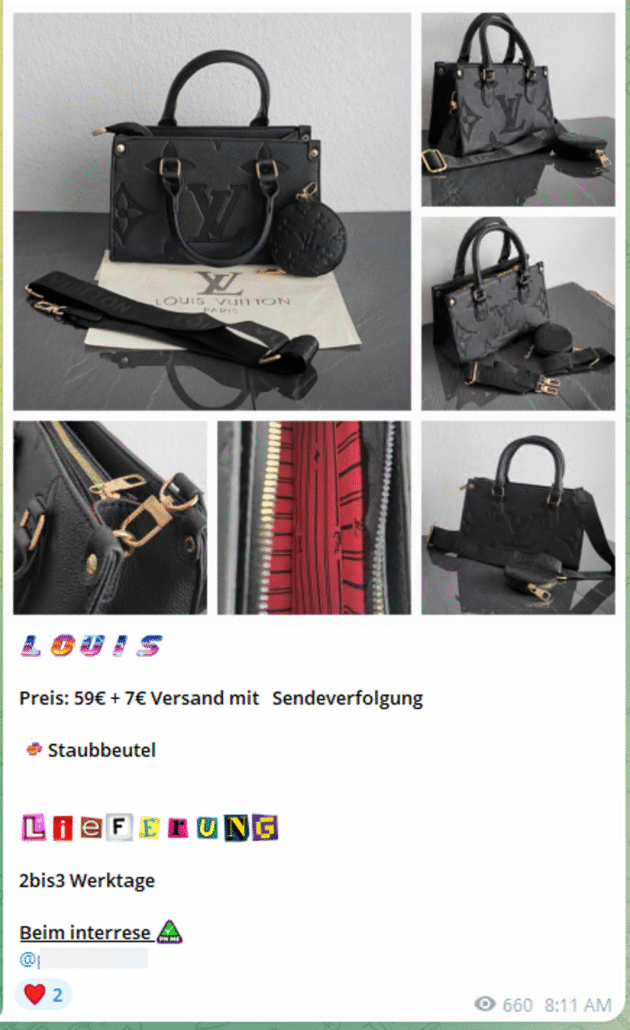
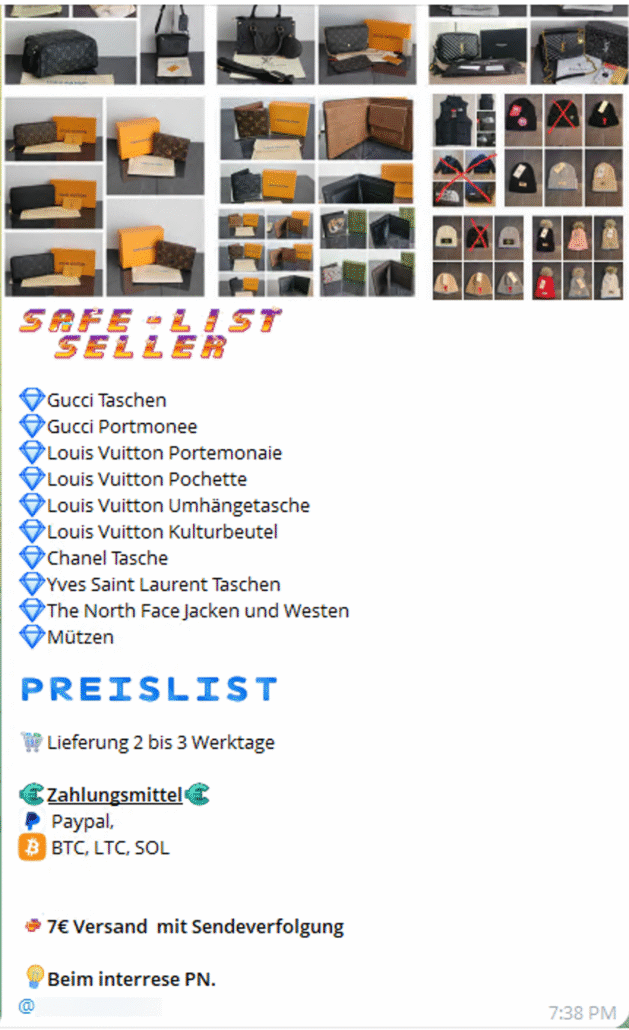
A screenshot from a Telegram conversation selling Louis Vuitton bags
For example, in the Telegram advertisement in German shown above, a “Gucci” bag is offered for €59 plus €7 shipping within Germany. This is a price point that sits in an ambiguous zone between obvious replica and plausible second-hand luxury.
This spectrum, from transparent imitation to deceptive authenticity, reflects not just counterfeiting, but a parallel market of trust, signaling, and perceived legitimacy.
When searching for this bag on Google, you can see it is sold for more than €3,500.
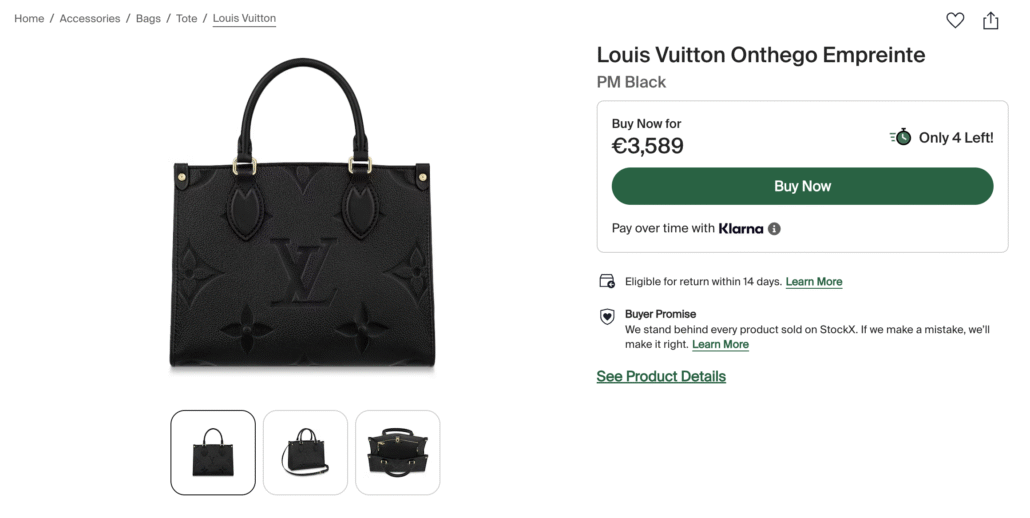
In some cases, there are whole websites that offer fake merchandise out in the open.
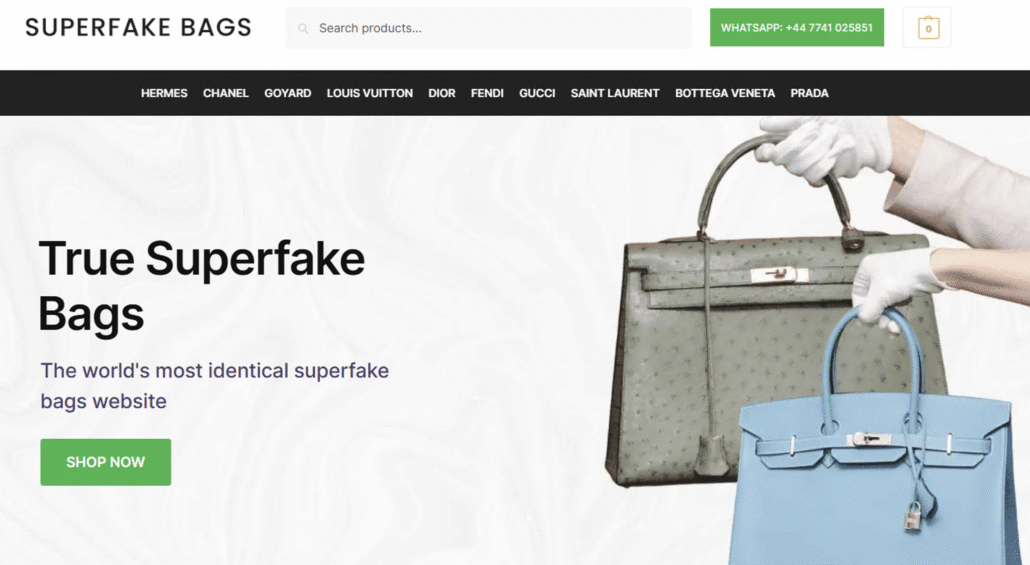
A fake website for luxury bags, advertised on the dark web
In this case, a paradox website title calls the bags “True Superfake.” The seller is aware of the nature of counterfeit but positions it as an undetectable one offering Hermes, Chanel, Gucci, Louis Vuitton, and others.
Below you can see how we found advertisements to buy Bvlgari merchandise.

An advertisement for Bvlgari products (Flare link to post, sign up for the free trial to access if you aren’t already a customer)
When we tried accessing the URL via browser, we came across this notification that states that this domain is seized due to illegal activity, and that you should buy from the official Louis Vuitton website only.
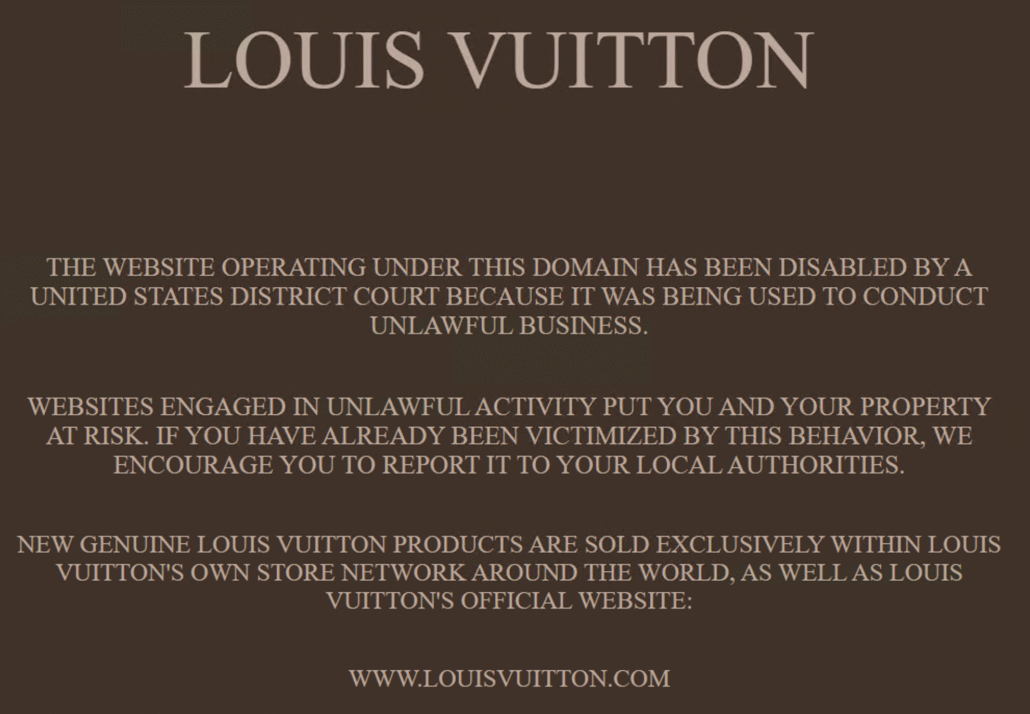
The notification that shows up when logged in to the Bvlgari website promoted in the underground
In addition, you can also find listings of products that sometimes don’t add up. It’s hard to say whether this is counterfeit, second hand, or stolen goods traded over the Telegram channel.
A screenshot from a Telegram group that sells luxury goods
And this isn’t solely about bags. There’s a whole underground industry covering clothing, machinery, household goods, and more.
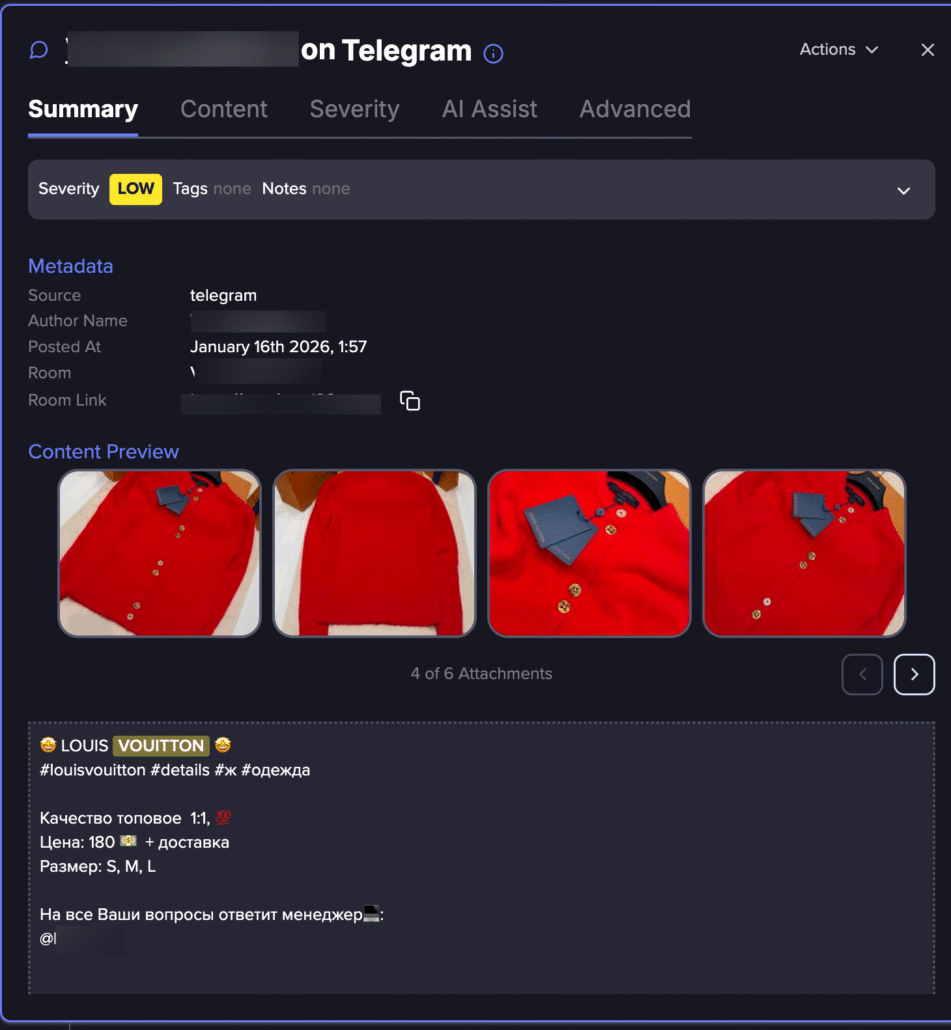
Louis Vuitton women’s clothing sold in a Telegram channel for 180 roubles (Flare link to post, sign up for the free trial to access if you aren’t already a customer)
Automate Monitoring Scams Related to Your Brand
The Flare Threat Exposure Management solution empowers organizations to proactively detect, prioritize, and mitigate the types of exposures commonly exploited by threat actors. Our platform automatically scans the clear & dark web and prominent threat actor communities 24/7 to discover unknown events, prioritize risks, and deliver actionable intelligence you can use instantly to improve security.
Flare integrates into your security program in 30 minutes and often replaces several SaaS and open source tools. See what external threats are exposed for your organization by signing up for our free trial.
Beware of Scammers in the Underground Fashion Economy
All that glitters is not gold. If a deal seems too good to be true, it usually is. You might think you’re getting the deal of a lifetime by paying $50 for a Birkin bag. But in reality, scammers drain $5,000 from your account, and your credit card details are sold on the dark web.
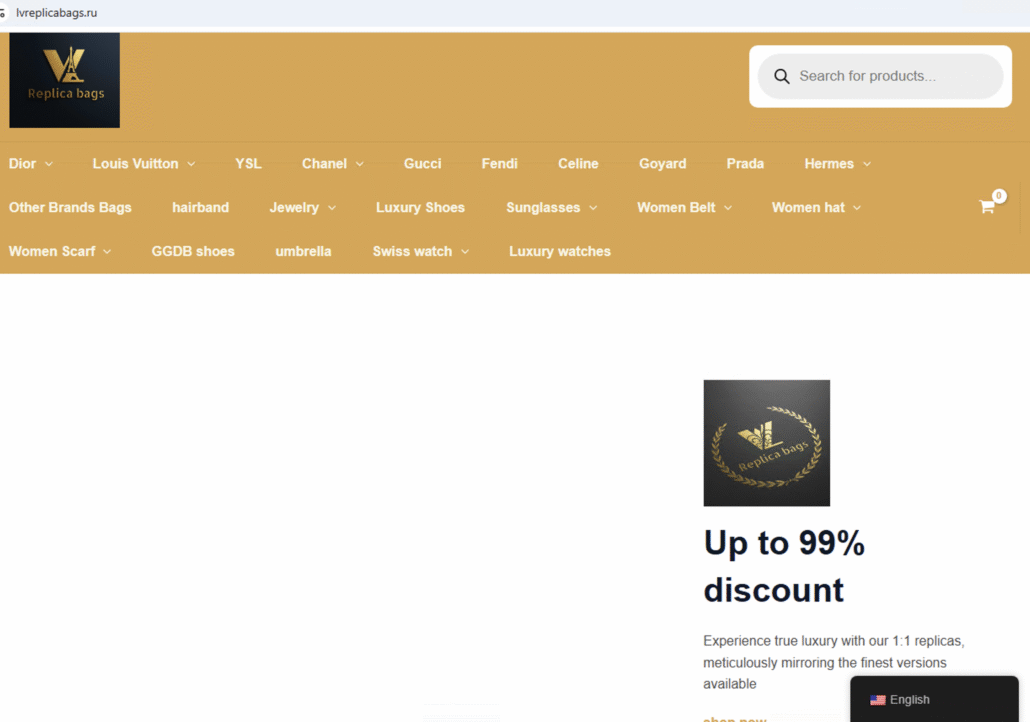
A website that promotes haute couture fashion with a 99% discount
Underground Economies Mirror Legal Economies
The underground economy of haute couture reveals a structural reality that extends far beyond counterfeit handbags or isolated fraud schemes. What appears on the surface as a niche problem of luxury replicas is, in practice, a complex economic system where knowledge, trust, logistics, and capital flows intersect.
Couture operates in a space where technical protections are weak, expertise is mobile, and authenticity is socially constructed rather than cryptographically enforced. This makes it uniquely vulnerable to parallel markets, and not only of fake goods, but of money laundering, brand impersonation, and legitimacy arbitrage.
In this ecosystem, luxury items function less as fashion and more as financial instruments: vehicles for laundering money, storing value, signaling status, and converting illicit capital into socially acceptable assets. Counterfeits, “true superfakes,” stolen goods, and even genuine merchandise all coexist within the same shadow economy, differentiated not by legality, but by narrative, perception, and trust.
Ultimately, the underground couture market is not a deviation from the fashion industry, but it is an emergent property of it. Wherever exclusivity, high margins, and symbolic value exist, an underground layer will inevitably form. Not as an anomaly, but as a mirror economy operating under the same incentives, just without the runway.