Dark web monitoring and PII exposure detection for employees
Beat Attackers in the Race to Identity Exposures
Identity Exposure Management
Flare combines industry-leading coverage of exposed credentials and stealer logs with automated workflows to reduce breach risk in seconds, not days.
$167K
Avoided labor costs
321%
Overall return on investment (ROI)
25%
Lower risk of severe data breach


When accounts fall, risk rises
Exposed Credentials are an Open Door for Attackers
Millions of Corporate Credentials are Exposed Every Week
Your team is under constant pressure from a steady wave of compromised user accounts, giving attackers an endless pipeline of opportunities to exploit.

Attackers Find New Exposures at Scale
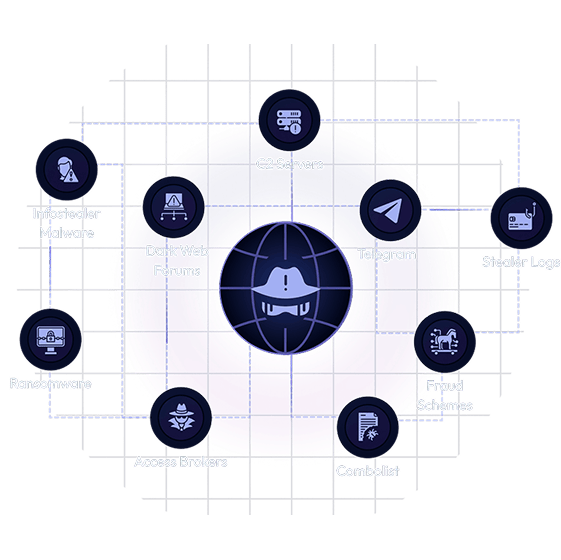
When it comes to exposed identities, It’s relatively easy for attackers to find the proverbial needle in the haystack. They efficiently parse fresh stealer log datasets to find corporate logins.
Speed is the Real Weakness
The faster attackers move, the higher their success rate. They deploy account takeover and session hijacking techniques to access your environment without detection.

Tracking and Remediation are Costly and Noisy
Identity investigations are complex, and often take hours to complete. Forrester research estimates the cost of resetting credentials at $70 per instance.

Flare is here to bring light into darkness
Flare Turns Credential Chaos into Clarity
The Industry’s Best Coverage of Identity Exposures
Backed by our world-class research team, Flare delivers the most comprehensive coverage of leaked credentials and stealer logs to give you visibility into current and emerging threats.
Near Real-Time Detection
Flare works around the clock adding new identity exposures to the platform in near real time, so you are alerted as soon as a new exposure is brought to the black market.
Automated Validation and Remediation with Entra ID
Entra ID users can connect their environment to Flare for automatic validation and remediation of exposures — even if they’re discovered at 2AM on a weekend.
Proven Risk Reduction and Cost Savings
According to a Forrester Total Economic Impact study, Flare’s IEM capabilities drove a 25% drop in severe breach risk, and saved teams 1300 analyst hours annually.
“The difference with Flare is the fact that their intelligence is deeper and more detailed. Being able to produce malware logs, copies of data, data leaks, and the like — it is very powerful for us to have that visibility. There are very few vendors in that space able to do what Flare does.”
Senior Incident and Hunting Specialist

Protect your organization
Flare’s Identity Exposure Management Toolkit
Flare equips security and threat intelligence teams with a wide array of tools to effectively manage identity threat exposures.
Book a DemoEntra ID Exposed Credential Validation & Remediation
Quickly validate and fix identity exposures directly against your Entra ID environment.
Identity Profile & Blast Radius Visualization
At-a-glance view of external risks to your users and potential adversary attack paths.
Leaked Credentials Browser
Agile, intuitive investigations across Flare’s world-class exposure database.
Stealer Log Events
Deep visibility into stealer log events for maximum investigation context.
Dark Web Monitoring of Access Brokers
Track dark web chatter from initial access brokers for early compromise indicators.
Robust API Endpoints & Integrations
Enterprise-proven APIs to embed identity exposure management into core security workflows.
EXTENDING SECURITY TO YOUR PEOPLE
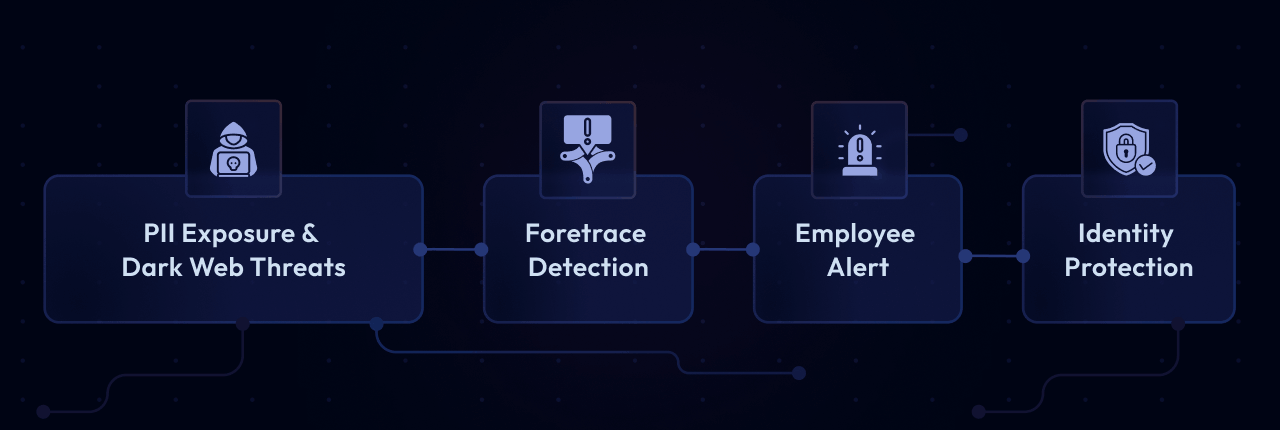
Extend the Power of IEM to Your Employees with Foretrace
The proliferation of infostealer malware and remote work has created a complex new reality - personal and corporate identities are increasingly entangled. Foretrace extends the same identity intelligence your security team relies on to the employees who need it most.
Key Outcomes
Results You Can Expect With Identity Exposure Management
According to Forrester Consulting’s Total Economic Impact™ study, Flare delivered measurable benefits over the first 3 years.
321% ROI
Payback in <6 months
25% Reduced Breach Risk
$509k in associated savings
1300+ Hours Reallocated
$167k labor cost savings
What to know about identity exposure management
Frequently Asked Questions
What is IEM?
Identity Exposure Management (IEM) is a security approach that continuously monitors for compromised credentials and session tokens across the dark web, Telegram channels, and other sources where threat actors trade stolen data.
Unlike traditional identity security products that focus on authentication and access controls within your environment, IEM looks outward to detect employee credentials that have been exposed before attackers can use them.
Flare’s IEM solution pairs comprehensive credential monitoring with automated validation and remediation workflows. When exposed credentials are detected, the platform can automatically verify whether passwords are still valid against your identity provider and trigger remediation actions like forcing password resets, revoking active sessions, or flagging accounts as compromised in Microsoft Entra ID.
Why is IEM especially important now?
The threat landscape has fundamentally shifted in this era of “logging in” instead of “hacking in.” Infostealer malware now infects millions of devices globally, harvesting not just passwords but session cookies that allow attackers to bypass multifactor authentication entirely. These stolen credentials appear in dark web marketplaces and Telegram channels within minutes of infection, giving threat actors a window to access corporate systems before anyone knows there’s a problem.
Traditional security controls assume credentials are either protected or breached in a single event. In reality, credentials leak continuously through phishing, malware, and third-party breaches. According to Verizon’s Data Breach Investigation Report, stolen credentials are involved in 88% of basic web application attack breaches. And with 46% of personal device stealer logs containing corporate credentials, the line between personal and professional exposure has effectively disappeared. In addition, the median time between ransomware victim disclosure and detection of related stolen credentials is two days, suggesting that ransomware operators frequently leverage infostealer malware. IEM addresses this by providing continuous visibility into credential exposure and automating the response.
According to our research, enterprise identity exposure is projected to reach 15-16% of all infostealer infections by late 2026 under baseline assumptions. However, this number could be 20% (one in five infections yield enterprise credentials) as early as Q3 2026. Read the full details in our 2026 State of Enterprise Infostealer Identity Exposure report.
How can IEM save you money on remediation?
Remediating identity exposures is expensive. Forrester puts the cost of a single password reset at $70, factoring in IT overhead and loss of productivity, and those costs quickly add up across hundreds or thousands of annual incidents.
Time compounds the problem: organizations average 11 hours to investigate a single identity-related alert. With threat actors bypassing MFA and weaponizing valid credentials, security teams remain locked in a cycle of investigation and cleanup.
With IEM, security teams can continuously monitor for identity exposures and automate remediation within minutes.
The business case for IEM extends well beyond risk. Forrester’s 2025 Total Economic Impact study quantifies the value: 321% ROI for Flare customers. Organizations attributed this return to a 25% decrease in the likelihood of severe data breaches and $167,000 saved annually in threat intelligence labor. These aren’t abstract benefits; they translate to faster detection, fewer costly incidents, and less time lost to investigations.

Learn from the best sources
Learn From World-Class Security Experts

“What used to take about 1500 hours to complete can now be done in 1 week. Flare allows me to empower junior analysts to do dark web investigations that were previously impossible, hence liberating bandwidth.“
Senior Security Specialist at a MSSP
“Other solutions would present us with thousands of potential leaks which were impossible to work with for our small team, Flare was the only one that could successfully filter and prioritize data leaks with their 5-point scoring system.”
CTI Director at a Major North American Bank
“What used to take about 1500 hours to complete can now be done in 1 week. Flare allows me to empower junior analysts to do dark web investigations that were previously impossible, hence liberating bandwidth.”
Senior Security Specialist at a MSSP
“We audited dozens of different solutions and Flare was the only one making CTI easy and understandable for all, with the right data.”
Senior Advisor at a IT Services Industry
“Flare enables us to react quickly when threats are publicized. It helps us protect our brand and financial resources from data breaches.”
CISO in a Major North American Bank
“We audited dozens of different solutions and Flare was the only one making CTI easy and understandable for all, with the right data.”
Senior Advisor at a IT Services Industry
Verified Reviews
4.9
Customer Success Stories
Check out our case studies to see real life examples of how security teams use Flare to reduce risk.

Book a Demo