
By Assaf Morag, Cybersecurity Researcher
Illegal sports streaming platforms aren’t simple copyright infringement operations. In 2026, they represent a mature underground ecosystem combining cybercrime, malware distribution, credential theft, financial fraud, and large-scale monetization networks. Major global sporting events (including soccer leagues, UFC fights, Formula 1 races, NBA playoffs, and international tournaments) consistently drive spikes in malicious streaming activity across both the open internet and underground communities.
Threat actors increasingly leverage illegal sports streaming demand as an entry point into broader cybercriminal operations. Fake streaming portals, cloned broadcast sites, Telegram distribution channels, IPTV resellers, and credential-sharing marketplaces are now deeply intertwined with malware campaigns, advertising fraud, phishing infrastructure, and identity theft operations.
With billions of viewers expected to tune in to the FIFA World Cup, threat actors are already laying the groundwork for one of the most profitable cybercrime seasons by turning every “free stream” link into a potential gateway for credential theft, malicious browser extensions, fake mobile applications, and large-scale tracking infrastructure.
About this World Cup Series
The United States, Canada, and Mexico have been selected to host the 2026 FIFA World Cup. As of early April 2026, the lineup of all 48 teams set to compete in the final stage is now complete.
How are threat actors responding? What’s already emerging across deep and dark web communities?
This blog is part of Flare’s World Cup 2026 Cybercrime Series, a collection of focused research pieces examining the evolving threat landscape surrounding the tournament. The series explores key areas including phishing infrastructure, fraud and scams, infostealer attacks, illegal streaming services, illicit betting platforms, insider threats, and other cybercriminal activities targeting the 2026 World Cup.
Key Findings About Illegal World Cup Streaming Broadcasts
- Illegal streaming infrastructure is already active: Threat actors are promoting World Cup streaming services across Telegram, Facebook, Discord, Reddit, and other platforms weeks before the tournament begins.
- These platforms are malware delivery systems: Research shows that nearly 40% of users who access illegal streams experience direct financial losses due to scams, fraud, or compromised payment information.
- Content acquisition and distribution are industrialized: Operators use captured satellite feeds, compromised broadcaster accounts, and cascading restreaming infrastructure to redistribute a single legitimate subscription to thousands of viewers.
- Monetization extends far beyond ads: Threat actors generate revenue through credential theft, IPTV subscriptions, malware affiliate programs, data harvesting, cryptocurrency payments, and affiliate fraud.
Detect Stolen Credentials and Brand Impersonation From Illegal Streaming Ecosystems
Illegal streaming portals are active malware delivery and credential theft operations. Flare monitors Telegram channels, dark web forums, and stealer log marketplaces to detect when your employees or customers are compromised through these campaigns.
Illegal Streaming on Instant Messaging, Deep and Dark Web
Since the World Cup kickoff is still weeks away, there are no actual live game broadcasts yet. However, if we predict the future based on the past, these broadcasts will appear minutes before the official kickoff and persist until the winners raise the trophy. Below you can see what happened in the 2022 World Cup broadcast:
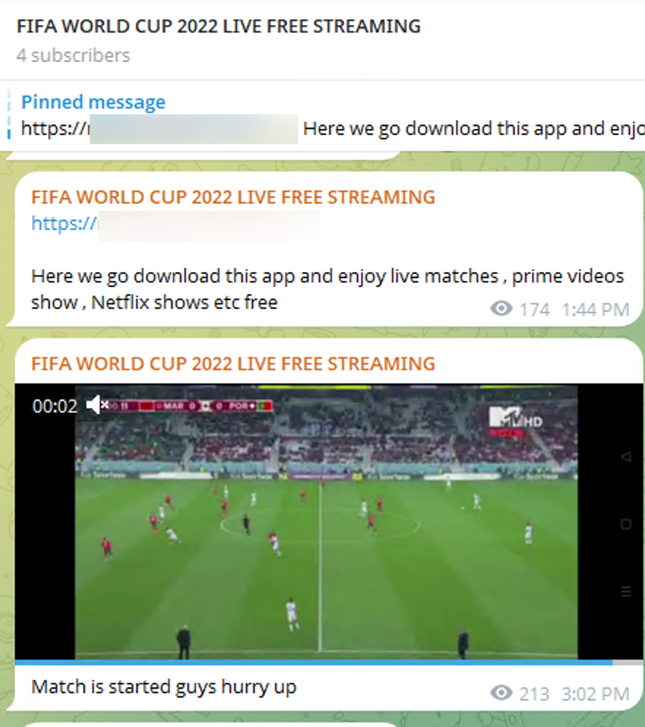
A free live stream of 2022 FIFA World Cup, advertised on Telegram
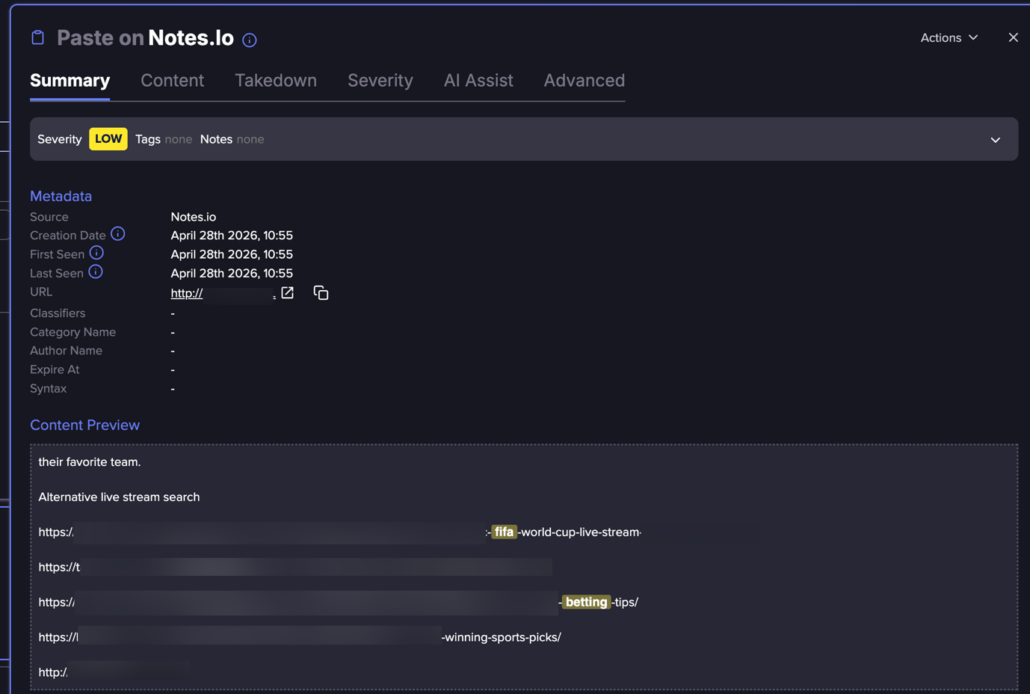
Illegal streaming is offered through Notes.io, as demonstrated by a post on Flare (Flare link to post, sign up for the free trial to access if you aren’t already a customer)
We have seen hundreds of those promotions on Telegram, and as time goes by and the World Cup kickoff approaches, advertisements about this year’s broadcasts continue to grow. Below is an advertisement:
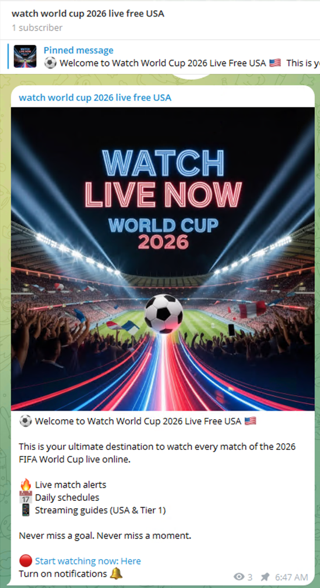
2026 FIFA World Cup live streaming ad
We can also see some hype on other platforms. For instance, a dedicated group on Facebook offers 2026 FIFA World Cup live stream access online.

Facebook dedicated group offers illegal stream
The Scale of Illegal Sports Streaming Broadcast
The global sports broadcasting market generates tens of billions of dollars annually. Premium broadcasting rights for competitions such as the UEFA Champions League, Premier League, NFL, NBA, UFC, and Formula 1 have become increasingly fragmented across subscription platforms, streaming services, and regional licensing agreements. Fans are often forced to navigate a maze of providers simply to follow their favorite teams and athletes.
The 2026 FIFA World Cup represents the pinnacle of sporting events. Across 104 matches played over six weeks, the tournament is expected to attract billions of viewers worldwide, while only around seven million spectators will have the opportunity to experience the matches live from the stadiums.
For the players, it is the ultimate stage: an opportunity to represent their nation before a global audience and possibly advance their career. For fans, it is something even bigger. The World Cup is one of the rare events capable of uniting entire countries behind a single flag, where political, social, and cultural differences are temporarily set aside in support of a shared anthem and national jersey. Every goal, save, and dramatic moment becomes part of a collective experience that millions are determined not to miss.
For cybercriminals, it’s the time to earn some extra money through illegal broadcasts. There are numerous methods:
- Illegal IPTV services
- Browser-based streaming portals
- Telegram broadcast channels
- Piracy-focused Discord communities
- Fake mobile streaming applications
- “Mirror” streaming websites
- Resold compromised accounts
- Credential-sharing infrastructure
Many of these operations operate like organized commercial cybercrime services.
How Modern Illegal Streaming Ecosystems Operate
Modern illegal streaming operations generally consist of two main stages: content acquisition and distribution.
Content Acquisition
Operators typically obtain sports broadcasts through several methods:
- Captured satellite feeds
- Re-streamed legitimate subscriptions
- Compromised broadcaster accounts
- IPTV source redistribution
- Insider access abuse, such as broadcast staff who leak the feed
- Direct signal relays from regional providers
In some cases, a single legitimate subscription is redistributed to thousands of downstream viewers through cascading restreaming infrastructures.
Traffic Distribution Infrastructure
Traffic distribution has become one of the most mature and sophisticated components of the illegal sports streaming ecosystem. Operators rely on a resilient mix of URL shorteners, rapidly rotating domains, CDN abuse, bulletproof hosting providers, reverse proxies, Telegram channels, Discord invitation networks, SEO poisoning techniques, and large-scale social media spam campaigns to attract and redirect users while evading takedowns.
Around major sporting events, this infrastructure becomes highly dynamic. Threat actors frequently register hundreds or even thousands of new domains in the hours leading up to a match, ensuring a constant supply of replacement streaming portals as existing sites are blocked, reported, or removed. These domains frequently imitate legitimate sports brands, broadcasters, or event names using typosquatting and regional language variations (for instance, “ufc-hdstream” or “sports247hd”).
Another major component of the distribution infrastructure is the marketing layer, which spans Telegram, Facebook, WhatsApp, Discord, Reddit, Twitter, TikTok, and YouTube.
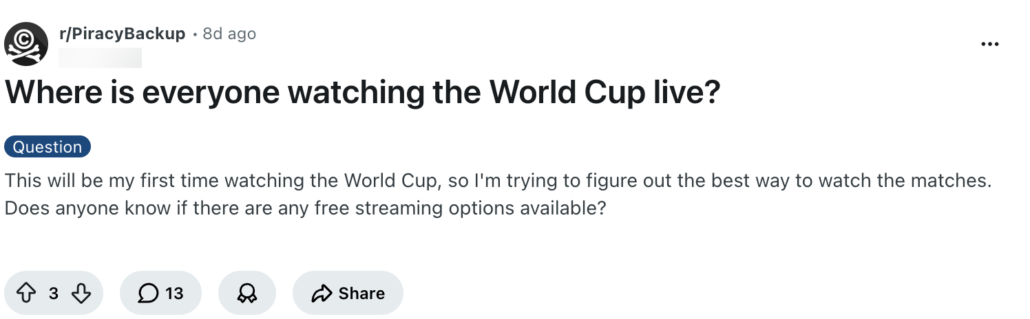
A question raised on Reddit about where to watch the World Cup live
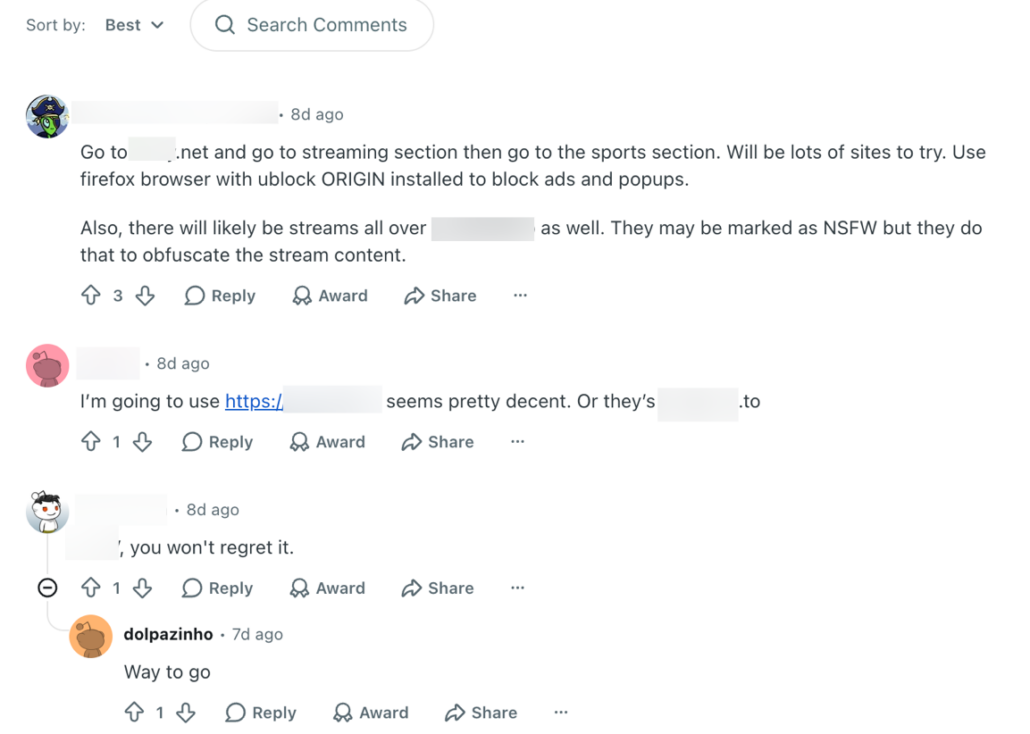
Thread of answers suggesting illegal options
Monetization: What’s in it for the Threat Actors?
At its core, the illegal streaming ecosystem is driven by profit. For some operators, revenue comes from relatively low-risk streams such as advertising, sponsorships, affiliate promotions, or driving traffic to products and services they control. For others, however, illegal streaming serves as the entry point to far more malicious activities, including malware distribution, credential theft, financial fraud, and data harvesting. Regardless of the method, the underlying objective remains the same: generating profit from user demand. As the old saying goes, when something is offered for free, you are often the product.
Below are some of the most common ways threat actors monetize illegal sports streaming operations.
Why Threat Actors Love Sports Piracy
Illegal sports streaming creates several advantages for cybercriminal operations:
- Global reach: Sports audiences span multiple regions, languages, and demographics.
- Massive predictable traffic: Major events generate millions of highly motivated users within narrow time windows.
- Low technical literacy among victims: Victims often willingly install malicious software if promised instant access.
- Emotional urgency: Users are more likely to ignore security warnings during live events.
- High monetization potential: Multiple revenue streams can be stacked simultaneously.
Common monetization methods include:
- Legitimate and malicious advertising: Many illegal streaming sites monetize traffic through advertising networks. While some display conventional ads, others rely on aggressive pop-ups, malicious redirects, fake software updates, and scam advertisements that generate significantly higher revenue per visitor.
- IPTV subscriptions: Operators often upsell users from free streams to paid IPTV services that promise access to thousands of premium channels, sports events, and pay-per-view broadcasts, creating a recurring revenue stream.
- Data harvesting: Streaming portals frequently collect user information such as email addresses, IP addresses, browsing behavior, device fingerprints, and location data, which can be monetized directly or sold to third parties.
- Affiliate fraud: Threat actors earn commissions by directing users to gambling platforms, betting services, VPN providers, cryptocurrency exchanges, adult content sites, or other affiliate programs through embedded links and redirects.
- Credential theft: Some platforms deploy phishing pages, malicious scripts, or malware designed to steal usernames, passwords, session cookies, and streaming account credentials that can later be sold or abused.
- Cryptocurrency payments: Illegal streaming and IPTV operators increasingly accept cryptocurrency payments, allowing them to receive subscription fees, donations, and advertising revenue while reducing financial oversight and increasing anonymity.
- Malware installs: Certain streaming sites generate revenue by distributing malware, including infostealers, adware, spyware, and browser hijackers. Operators are often paid per successful installation through malware affiliate or pay-per-install programs.
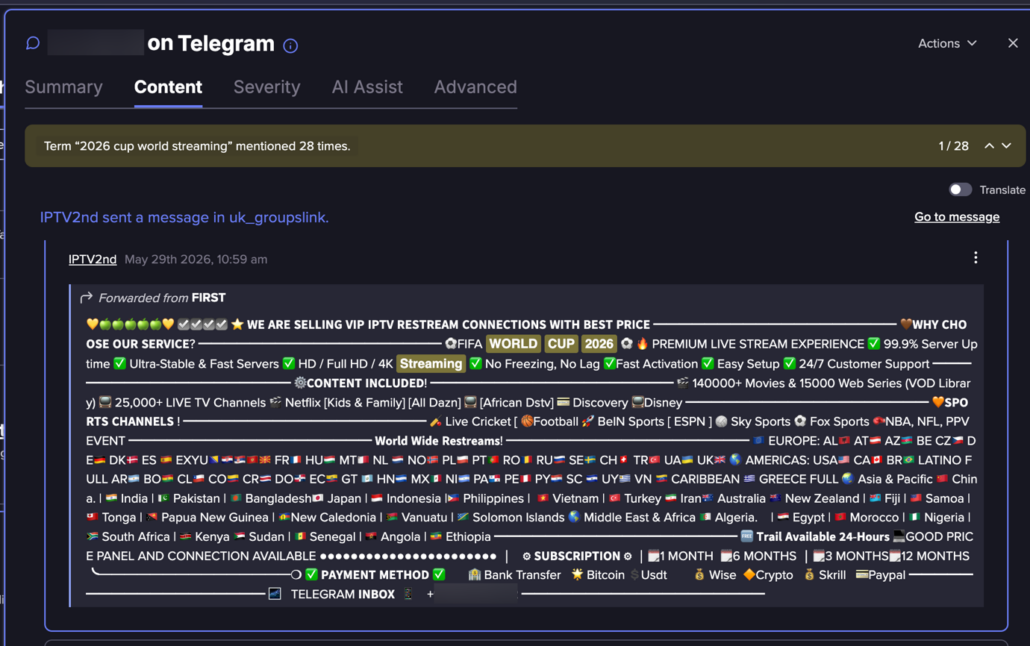
World Cup broadcast ads as collected by Flare (Flare link to post, sign up for the free trial to access if you aren’t already a customer)
Malware Delivery Through Illegal Streams
One of the most overlooked aspects of illegal sports streaming ecosystems is malware delivery.
Public reporting has increasingly highlighted this threat. In early 2026, security researchers reported that cybercriminals were actively exploiting demand for free Formula 1 race streams through fake streaming portals, malicious VPN downloads, fraudulent streaming tools, and ClickFix-style social engineering campaigns. Many of the sites promoted “free race access” while delivering malware, credential theft tools, or aggressive tracking infrastructure in the background. Researchers specifically identified illegal streaming portals as a recurring malware distribution mechanism targeting sports fans.
A study from November 2025 highlighted the financial and security risks associated with illegal streaming services and modified streaming devices. Researchers found that 32% of users who accessed illegal streams experienced direct financial losses due to scams, fraud, identity theft, or compromised payment information, with average losses far exceeding the cost of legitimate subscriptions. The report also warned that piracy apps, modified streaming devices, and unauthorized streaming websites are frequently used as malware delivery platforms, exposing users to spyware, credential theft, banking fraud, and other forms of cybercrime disguised as free access to premium sports and entertainment content.
Below are some of the methods attackers are using to deliver malware:
- Fake browser updates
- Malicious browser extensions
- Drive-by redirects
- Fake CAPTCHA pages
- Click fraud loaders
- Crypto mining scripts
- Infostealer malware
- Mobile APK sideloading
In many observed cases, the seemingly harmless “Play” button on an illegal streaming website serves as the starting point of a much more complex attack chain. Rather than immediately loading the requested broadcast, users are often redirected through multiple advertising, tracking, and traffic-distribution layers before ultimately landing on pages designed to deliver malicious payloads such as infostealers and banking trojans.
For threat actors, this combination of urgency, emotion, and massive audience reach makes illegal streaming platforms highly effective malware distribution channels.
Recommendations for Security Teams
The intersection of illegal streaming and cybercrime creates tangible risks for organizations, particularly during major sporting events when employees are most likely to seek out unauthorized streams. Security teams can take several proactive steps to reduce exposure:
- Educate employees ahead of major events: Security teams can issue targeted awareness communications before high-profile tournaments like the World Cup, reminding staff that “free stream” links are among the most common vectors for account compromise, banking fraud, identity theft, device infections, credential leakage, and cryptocurrency theft. Framing the risk in terms of personal financial loss (not just corporate policy) tends to drive higher engagement with these messages.
- Monitor for credential exposure from infostealer infections: Employees who visit illegal streaming sites on personal or corporate devices are prime targets for infostealer malware. Security teams can monitor for corporate credentials appearing in stealer log marketplaces and Telegram channels, enabling rapid password resets and session invalidation before threat actors exploit the access.
- Enforce browser extension and software installation policies: Malicious browser extensions are a primary delivery mechanism on illegal streaming portals. Security teams can restrict browser extension installations to approved lists and block sideloaded APKs on managed mobile devices for a more effective approach to reducing this attack surface.
- Increase DNS and web filtering around event windows: Illegal streaming infrastructure spikes dramatically in the hours before major matches. Security teams can update DNS filtering and web proxy rules to block known illegal streaming domains, newly registered domains with sports-related keywords, and categories associated with piracy and unauthorized streaming.
- Monitor for brand impersonation and typosquatting: Organizations in the sports, media, entertainment, and broadcasting industries face heightened brand impersonation risk during events like the World Cup. Security teams can monitor for typosquatting domains, fake social media accounts, and unauthorized Telegram channels using their brand name to lure victims, enabling faster takedown requests.
- Track threat actor activity in underground communities: Threat actors openly advertise illegal streaming infrastructure, IPTV services, and compromised broadcast credentials in Telegram channels, dark web forums, and piracy communities. Security teams can monitor these sources for mentions of their organization, leaked employee credentials, or compromised accounts tied to their streaming or broadcasting services.
The Aftermath: More Than Just Piracy
Illegal sports streaming ecosystems serve as a front for sophisticated underground economies that blend piracy, cybercrime, malware distribution, and large-scale fraud operations. What appears on the surface as a “free stream” is often the entry point into a much larger infrastructure involving credential theft, malicious advertising networks, IPTV fraud, cryptocurrency monetization, and malware delivery pipelines.
As major sporting events such as the 2026 FIFA World Cup continue to attract massive global audiences, threat actors will increasingly exploit this demand, transforming piracy platforms into highly effective distribution channels for broader criminal activities. In many cases, the stream itself is merely the lure, and the real product is the user.
Detect Stolen Credentials and Brand Impersonation From Illegal Streaming Ecosystems
Illegal streaming portals are active malware delivery and credential theft operations. Flare monitors Telegram channels, dark web forums, and stealer log marketplaces to detect when your employees or customers are compromised through these campaigns.