

By Assaf Morag, Cybersecurity Researcher
Can a compromised laptop put far more than one account at risk? Binance’s preliminary report of its latest security incident points to a DevOps engineer’s laptop as a possible entry point to systems involved in $6.3 billion in unauthorized withdrawals. The investigation is still unfolding, but the broader question is familiar: how much organizational access can an attacker gain through one device?
To explore that question, we examined 219 historical stealer log entries in Flare’s data containing 74 distinct usernames ending in @binance.com. Beyond exchange logins, the records associate Binance-domain usernames with authentication, development and monitoring services, including Okta, Git and Kibana. These are leads for investigation—not proof of 74 affected employees or successful access. No evidence reviewed connects these historical records to the newly disclosed incident.
Whether a business moves cryptocurrency, deploys software, or holds customer records, exposed credentials can offer an early warning to every organization. Their value comes from identifying what access may be at risk—and containing it before an attacker can use it.
Key Findings About Binance Domain-Identities
- Binance-domain identities appear in stealer logs across five years. 219 logs contain 74 distinct @binance.com usernames, with 58,846 general nested records such as credentials, cookies, files, and more (not all records are linked to Binance).
- The exposure reaches beyond exchange logins. Records pair Binance-domain usernames with Okta tenants, Kibana, Git, LastPass, Google identity, and JetBrains. One identity appears across Okta, Kibana, Git, and JetBrains.
- Raw counts overstate the picture. 22 LastPass records reduce to a single username-hostname pair, and identity counts overlap across services, so they cannot be added together.
Infostealer Exposure Monitoring
Find Out What One Infected Laptop Could Expose at Your Organization
Stealer logs can link a single corporate identity to sign-in, developer, and monitoring tools. Start a free trial to see where your company’s identities appear and contain that access before an attacker uses it.
Binance’s Security Incident Alert
In a Security Incident Update published on October 30, 2026, Binance said its preliminary investigation suggested that a compromised DevOps engineer’s laptop may have enabled an attacker to access a service container and submit unauthorized withdrawal transactions and that there was no evidence of wallet-private-key leakage. The company estimated the impact at approximately $6.3 billion, with around $3 billion frozen on chain through cooperation with blockchain partners. Binance pledged to cover all losses using its Secure Asset Fund for Users (SAFU) and company funds and committed to publishing a detailed technical post-mortem once the investigation was complete and the facts verified. An updated Proof of Reserves would follow remediation. Keep in mind that the exact root cause and aftermath are still being investigated.
Binance subsequently amended the announcement to clarify that deposits remained unaffected and continued to operate normally, correcting the original wording that described both deposits and withdrawals as suspended.
Why Binance Matters
Binance is a centralized cryptocurrency exchange where users can buy, sell, trade, and hold digital assets, with services spanning spot and derivatives trading, deposits and withdrawals. In July 2026, it reported 323 million registered users across more than 100 countries.
Its security depends on protecting the identities, devices, and systems that authorize asset movements, alongside wallet keys. The same principle applies to any organization: a compromised workstation can become a path to sensitive data, production systems or financial operations.
Our Research on Infostealer’s Exposure
While the investigation continues, we examined Flare’s historical infostealer data for credential exposure involving Binance. Our analysis offers a separate view of how organizational identities and access artifacts appear in stolen collections, what those records reveal, and which early warning signs can help security teams investigate and contain exposure before it escalates.
Three Ways Binance Appears in Stealer Logs
Our historical analysis examined 219 stealer logs over the past five years that contained at least one username value with the @binance.com email address (illustrating a Binance employee associated). Where a “stealer log” means a unique source document extracted from a single infected endpoint, and contains a collection entry or vendor-deduplicated event. Inside the dataset we found 58,846 nested records including credentials, cookies, files, etc. Mind that most of these records aren’t necessarily connected to Binance, as most of them are records of passwords, cookies, files that were found on these machines.
We focused on three views:
- records with an @binance.com username
- records with binance.com or its subdomains as the destination
- records matching both
This scope captures only part of the exposure. Customer investigations benefit from a broader, validated set of domains and identities, allowing more precise analysis. Here, these indicators provide a useful starting point.
As illustrated in the table above, there are 74 distinct usernames with @binance.com, so there are potentially 74 Binance employees’ data exposed across the past five years. These could be former employees, contractors, role/shared accounts, or a fabricated identity. The more interesting information is the dual match, since they increase the possibility that these identities are indeed connected to Binance and can potentially be records of employees. We analyzed this further as can be seen below.
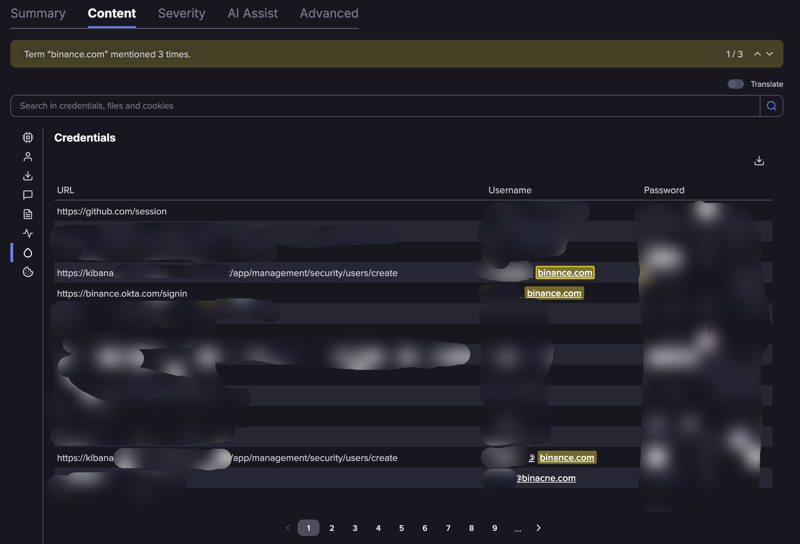
Binance domain mentions in Flare (Flare link to post, sign up for the free trial to access if you aren’t already a customer)
The Exposure Extends Across Several Systems
Across these nine service and environment patterns, we found 168 credential records containing 35 distinct @binance.com username strings across 49 log entries. Those usernames form 50 distinct username–host pairs, reflecting appearances across different destinations. Usernames and logs overlap between rows, so those columns should not be added.
* Okta affiliation was determined by binance.okta.com as destination URL and a username *@binance.com, while kibana affiliation was determined by a kibana URL pattern and username as *@binance.com.
The most relevant records pair Binance-domain usernames with authentication, development and observability services. One identity appears across Okta, Kibana, Git and JetBrains, establishes identifier co-occurrence of the email in that specific stealer log. Repetition matters: 22 LastPass records reduce to one username–hostname pair.
If the identities and access were validated, these associations could indicate how a compromised endpoint might expose access beyond an individual account. They do not establish valid credentials, employee ownership or compromised systems, and no evidence connects these historical records to the recent incident. Identity counts overlap across services and cannot be added. Jira, AWS console, and GitHub records use other usernames, providing collection context rather than direct evidence of Binance access.
A Historical Record Across the Three Categories
Flare’s data span across several years from February 2022 to October 2026. After removing duplicates, a yearly breakdown shows how the signals cluster over time.
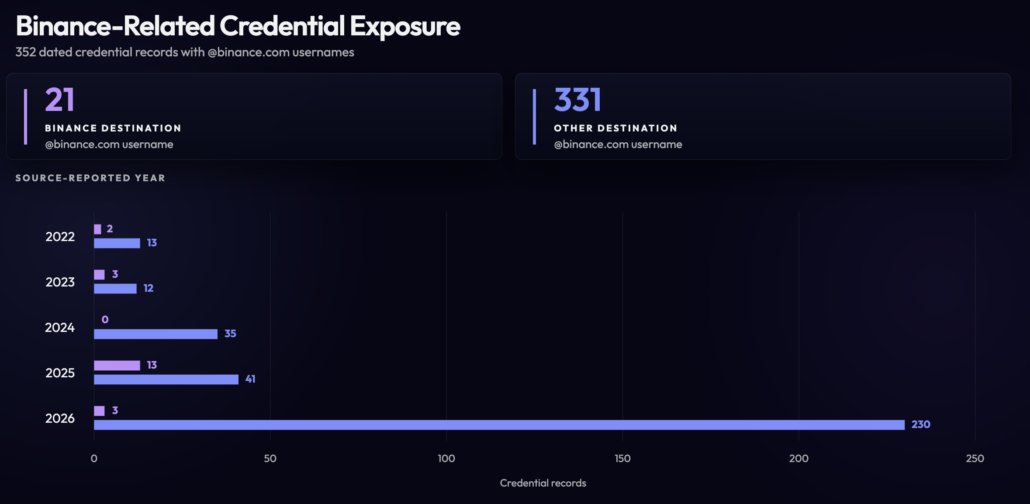
The aggregate figures may look alarming or time-consuming to view, but a yearly breakdown helps organize the signals into more focused leads. A smaller alert volume does not mean lower risk: when potential losses reach billions of dollars, even a few credible exposure signals can warrant urgent investigation.
One Item Shows Why the Surrounding Environment Matters
One repeated collection contained 16 distinct @binance.com usernames. One appeared in credential records for Okta, Google identity, Git, Kibana and JetBrains, connecting sign-in services with development and monitoring tools.
An exchange login suggests potential exposure of an individual account. The same identity appearing alongside sign-in systems, source-control tools and monitoring services raises a broader question: how much organizational access could those credentials provide if usable? These associations offer leads for investigation, while ownership of the destinations and successful access remain unverified.
Stealer logs can be fabricated. In this case we examined those logs and the evidence supports that these logs appear to be genuine, and could provide a valuable early warning. Once Flare ingests relevant data, automated workflows can notify customers by email or initiate credential validation, depending on the configuration, helping defenders assess the exposure and prioritize their response.
What this Exposure Means for Any Organization
A compromised device can expose more than an individual account. Work sign-ins, developer tools and administrative sessions may sit alongside personal browsing and unrelated accounts. The important question is which organizational systems an attacker could reach if those credentials or sessions remained usable. Our historical findings illustrate that potential exposure, but they do not establish the cause of the recent Binance incident.
This makes stealer logs valuable early-warning signals, provided they are validated. A company-domain username alone is not enough. Defenders need to confirm the identity, examine the destination, account for repeated records and determine whether the exposed access remains relevant. When Flare ingests relevant data, automated workflows can notify customers or initiate credential validation, depending on the configuration, helping teams prioritize investigation.
The response to infostealer exposure should extend beyond a password reset. Stolen cookies and authentication tokens can sometimes let attackers reuse authenticated sessions without repeating the login or MFA challenge. Changing a password does not necessarily invalidate that access.
Security teams should:
- Validate the exposure: confirm the identity, affected services, record dates and types of credentials or session artifacts exposed. Prioritize accounts with privileged access to sensitive systems.
- Assess the impact: identify connected applications and permissions, then review authentication and application logs for unauthorized access or sensitive actions already performed.
- Contain the compromise: investigate and remediate the affected endpoint, revoke sessions and refresh tokens where supported, reset compromised credentials and rotate exposed secrets. Verify that containment was effective.
- Reduce future exposure: limit persistent privileges, enforce phishing-resistant MFA and require additional authorization for high-impact actions. Continue monitoring for suspicious access or newly established sessions.
For an exchange, those actions may involve moving funds. Elsewhere, they could involve deploying code, exporting customer data or changing backups. The value of an exposure alert lies in identifying and containing that potential access before an attacker can use it.
One Laptop, Many Doors
Binance is today’s headline, but the pattern in its historical stealer log exposure belongs to every organization whose people sign in from laptops that can be infected. Across 219 logs and 74 distinct @binance.com usernames, the records show identities linked not just to exchange logins but to Okta, Kibana, Git, and JetBrains, which are the systems that connect an individual account to an organization’s wider operations. None of this proves valid credentials, employee ownership, or any link to the recent incident, and raw counts overstate the picture.
However, what the data does show is how much context a single stolen collection can hold, and why a company-domain username alone is never enough to act on. Defenders need to validate the identity, examine the destination, account for repeats, and then contain whatever access survives. That means revoking sessions and tokens, rotating exposed secrets, and limiting persistent privileges, because a password reset will not stop a stolen session cookie. For an exchange, the stakes are moving funds. For everyone else, they are deploying code, exporting customer data, or altering backups. The value of an exposure alert lies in finding and closing that access before an attacker uses it.
Infostealer Exposure Monitoring
Find Out What One Infected Laptop Could Expose at Your Organization
Stealer logs can link a single corporate identity to sign-in, developer, and monitoring tools. Start a free trial to see where your company’s identities appear and contain that access before an attacker uses it.