By Assaf Morag, Cybersecurity Researcher
Imagine that someone searches for a free PDF editor. They click a link on a website that seems legitimate, get bounced through a chain of disposable redirect domains, and download what looks like legitimate software. Buried inside the ZIP file is a hijacked Steam binary that silently loads an infostealer. Within minutes, every credential saved in every browser on that machine, including their FIFA account login, is packaged into a stealer log and traded on Telegram.
Multiply that by 130,000 logs containing FIFA-related credentials that Flare identified over a period of one year (April 2025-April 2026), and the scale of the exposure becomes clear. This is the collateral damage of industrialized credential theft, and it creates a growing attack surface as the 2026 World Cup approaches.
About this World Cup Series
The United States, Canada, and Mexico have been selected to host the 2026 FIFA World Cup. As of early April, the lineup of all 48 teams set to compete in the final stage is now complete.
How are threat actors responding? What’s already emerging across deep and dark web communities?
This blog is part of Flare’s World Cup 2026 Cybercrime Series, a collection of focused research pieces examining the evolving threat landscape surrounding the tournament. The series explores key areas including phishing infrastructure, fraud and scams, illegal streaming services, illicit betting platforms, insider threats, and other cybercriminal activities targeting the 2026 World Cup.
Key Findings About FIFA-Related Credential Exposures
- Nearly 130,000 infostealer logs containing FIFA-related credentials were identified by Flare, with over 2,500 exposed email/password pairs across the fifa.com and fifa.org domains. This exposure is driven by broad, indiscriminate infostealer infections rather than a targeted campaign against FIFA, meaning the credentials are collateral damage from industrial-scale credential theft that sweeps up everything on an infected machine.
- Infostealer-driven cybercrime is largely opportunistic. However, the sheer volume of accumulated credentials creates a growing risk as the tournament approaches, giving threat actors a large pool of accounts to sort through for high-value targets such as staff, partners, or vendors with access to internal systems.
- Flare researchers traced a complete infection chain of a victim with an email with a FIFA domain from a piracy search to credential theft in detail. A victim searching for a free PDF editor was led through a multi-stage redirect chain using disposable .cfd domains, landed on a fake download page impersonating Google Drive, and downloaded a ZIP file containing a HijackLoader (Rugmi) infection delivered via DLL side-loading of a legitimate Steam binary, with the final payload almost certainly being Lumma Stealer.
- Compromised FIFA credentials carry risk well beyond individual account takeover. Attackers with access to staff or partner credentials can potentially reach internal systems, CRM platforms, or ticketing backends, enabling manipulation of ticket inventories, phishing campaigns targeting fans, or lateral movement into cloud platforms and operational infrastructure tied to the tournament. A single compromised endpoint becomes a scalable attack surface with both financial and operational impact.
Detect Exposed Credentials Before They’re Weaponized
Flare continuously scans underground forums, marketplaces, Telegram channels, and combolists to identify compromised accounts tied to your corporate domains, enabling immediate remediation before credentials are traded, reused, or leveraged for lateral movement.
Organizational Credential Exposure
Whether conducting a threat intelligence review or a penetration test, the first step is discovery. We scoped our analysis to two domains owned and controlled by FIFA since 1995: “@fifa.com” and “@fifa.org”. These domains are owned and controlled by FIFA since 1995 and registered via CSC Corporate Domains, Inc. FIFA uses these domains internally to host the official website and to create email accounts for employees, contractors, and partners.
We utilized Flare’s Credential Browser feature to discover exposed assets (primarily email addresses and associated passwords) linked to these domains.
The sources of these credentials are primarily third-party breaches and combolists. These are uploaded to various underground forums and messaging groups, where they are shared or traded to facilitate cybercrime.
Exposure Summary
For fifa.com, we found a total of 1,184 sets of email/username and password in Flare.
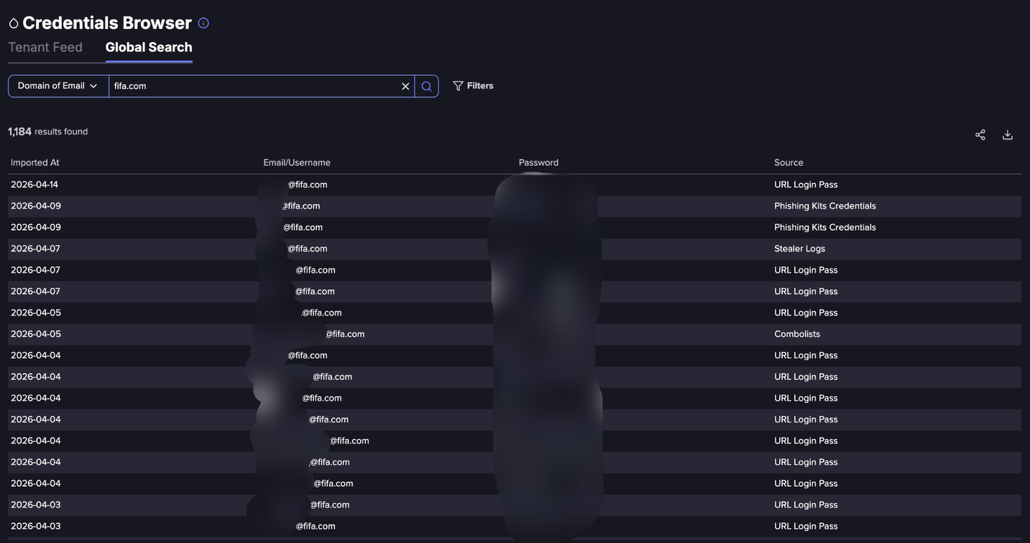
Flare’s Credential Browser search feature showing exposed credentials
For fifa.org, we found a total of 1,329 sets of email/username and password in Flare.
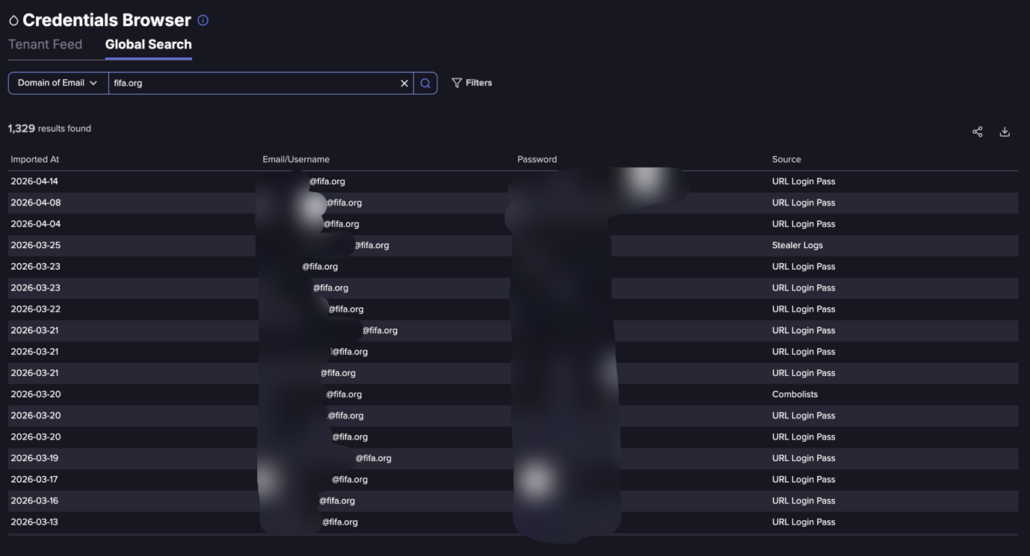
Flare’s Credential Browser search feature showing exposed credentials
What Can Attackers Do With FIFA-Related Stealer Logs?
Stealer logs containing credentials and session data from users of FIFA-related platforms (such as fifa.com or fifa.org) can be extremely valuable to attackers.
This risk escalates across several dimensions:
- Direct account access: With access to authenticated sessions, attackers can bypass login protections and directly access user accounts, enabling activities like ticket theft or resale fraud ahead of high-demand events like the World Cup.
- Internal system compromise: If any compromised credentials belong to staff, partners, or vendors, attackers may gain access to internal systems, CRM platforms, or ticketing backends. This opens the door to broader data exposure, manipulation of ticket inventories, or unauthorized access to operational systems. Thus, identifying “higher tier” FIFA credentials is a key priority for threat actors ahead of major events.
- Lateral movement: Attackers can reuse credentials across services (SSO, email, cloud platforms) to pivot deeper into organizational environments, potentially reaching sensitive data such as financial records, event logistics, or security plans. In the context of a global event, this could escalate into targeted disruption, tampering with ticket distribution, launching phishing campaigns against fans, or even interfering with event infrastructure.
Ultimately, infostealer data turns a single compromised endpoint into a scalable attack surface with both financial and operational impact.
Analyzing the Infostealer Data
Infostealers have become one of the most dominant and scalable threats in modern cybercrime.
Malware families like RedLine Stealer, LummaC2, and Vidar quietly harvest credentials, session cookies, autofill data, crypto wallets, and system fingerprints from infected machines, then exfiltrate them into structured logs that are traded across underground marketplaces and Telegram channels.
A single infection can expose dozens of corporate and personal accounts, while millions of such logs are continuously recycled, resold, and weaponized by initial access brokers and threat actors. Infostealers effectively collapse the boundary between home and enterprise environments, turning compromised endpoints into entry points for ransomware and data breaches.
When leveraging Flare to analyze infostealer activity over the past year, we identified nearly 130,000 logs containing at least one record associated with the domains fifa.com or fifa.org.
The infection trend remains relatively consistent over time, reinforcing a key insight: infostealer-driven cybercrime is largely opportunistic rather than campaign-specific. In other words, despite the heightened global attention surrounding FIFA and the 2026 World Cup, there is no clear indication of a targeted or coordinated campaign specifically aimed at FIFA users. Rather, these credentials are swept up as part of broad, indiscriminate infections at scale.
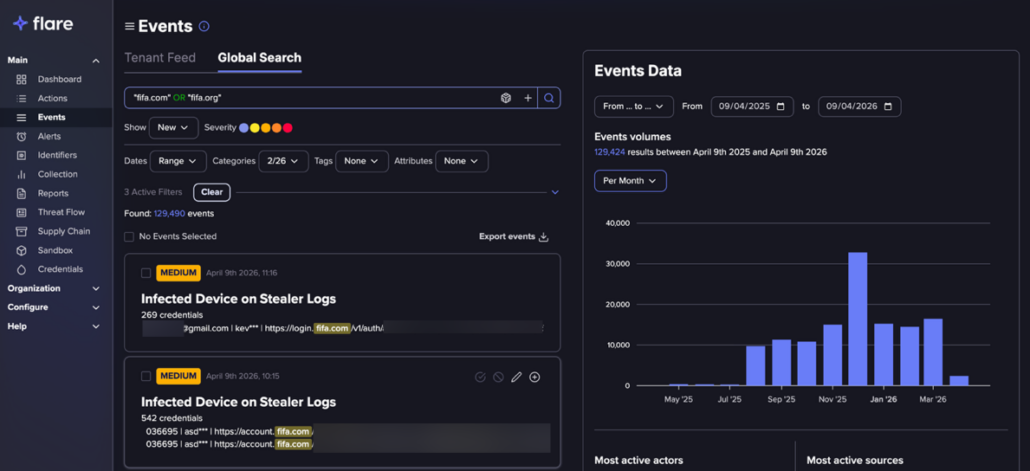
Searching for FIFA related stealer logs with Flare
Infostealer Family Distribution
We extracted a convenience sample via Flare’s API: the past 10 days for the fifa.com domain (727 distinct users) and a 60-day query for the fifa.org domain (10 distinct users). As expected, Lumma and Vidar infostealers dominate the dataset, consistent with their current market position.
Infostealer families distribution in our dataset
What Infostealers Collect
The infostealer data indexed on Flare contains detailed information about each infected machine.
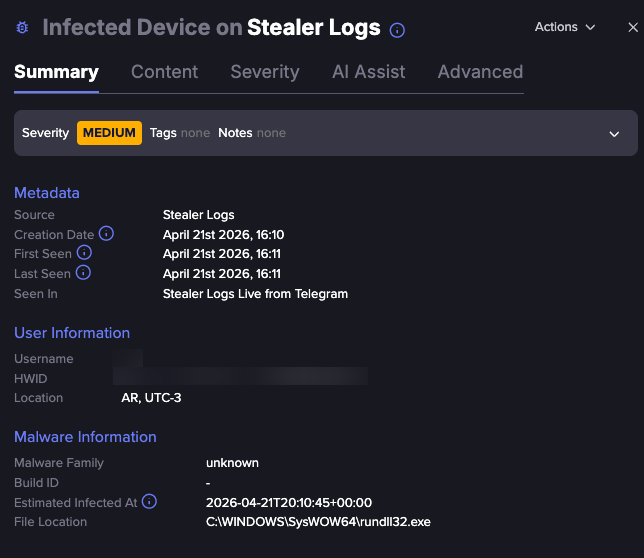
Data about an infostealer infected machine (Flare link to post, sign up for the free trial to access if you aren’t already a customer)
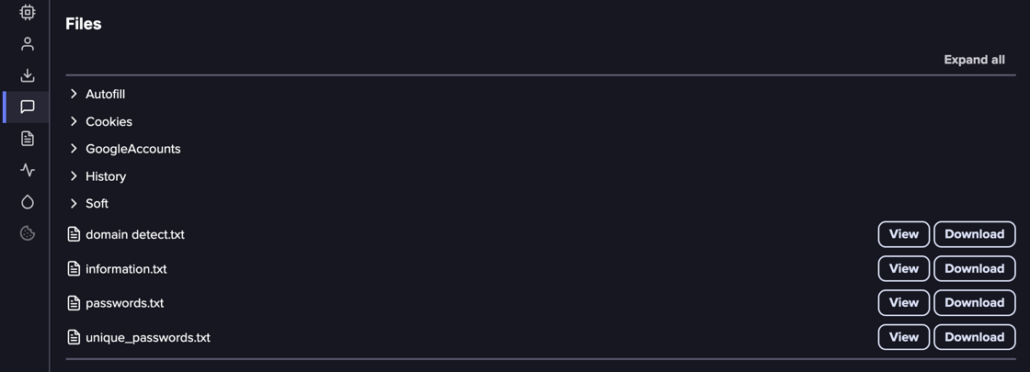
Infostealer infected machine files
- Autofill data: Everything from the browser’s autofill database, including credit cards, emails, passwords, logins, and other form data the browser automatically completes.
- Cookies: Session data stored by websites to enable persistent access. Whoever holds this data can access the websites the victim is currently logged into.
- Google Accounts: Account information associated with the victim’s Google profile.
- Browsing history: Full history, including URLs that may contain login details (e.g., https://user:[email protected]).
- Software tokens: Authentication and password information for desktop applications such as WhatsApp, Discord, and Telegram.
- Parsed aggregated lists: Extracted domains, credentials, and unique passwords organized for easy consumption by other threat actors.
Tracing a Real Victim’s Infection Sequence
The data Flare collects includes information about the malicious file’s execution path, which reveals how the victim was infected. Therefore, we can further learn about the malware. We analyzed our dataset and found that the majority of samples ran on Windows machines. We selected a recent, illustrative example to retrace the infection sequence:
C:\Users\<<Reducted>>\Downloads\pdf-xchange_editor_plus_(2026)_full_español_[mega].exe
Step 1: The Search
The victim searched for a free version of PDF-XChange Editor Plus.
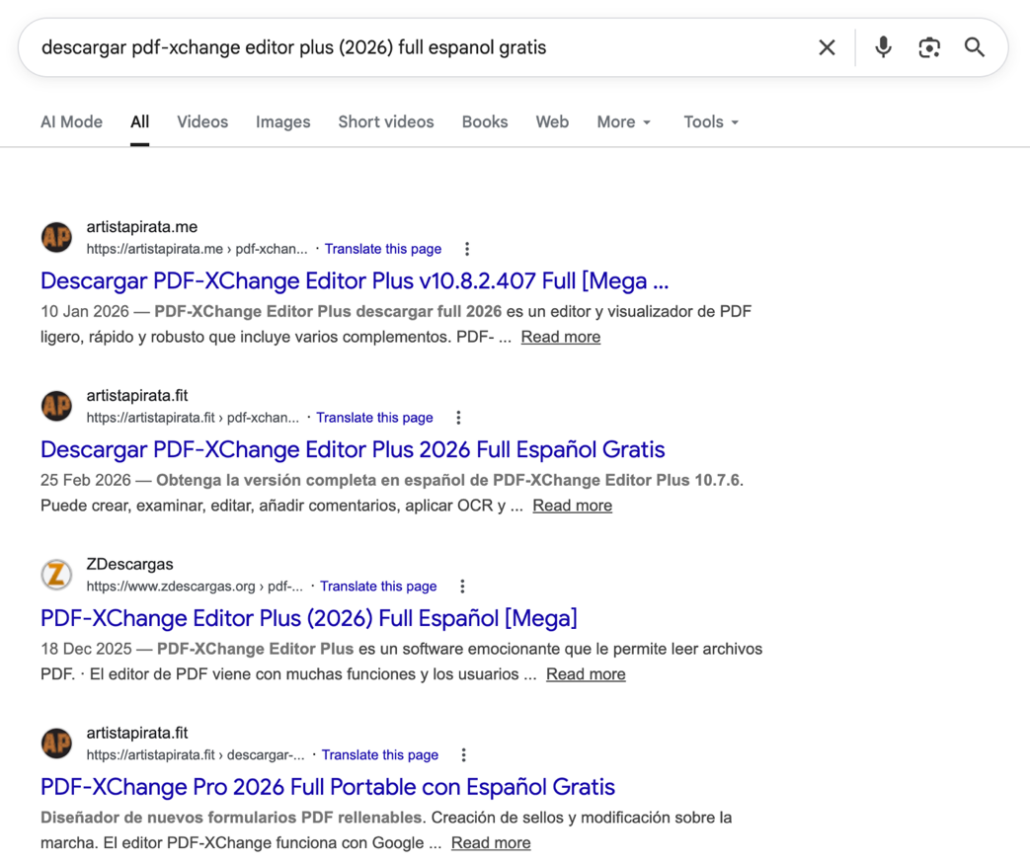
All of the top results led to malicious downloads. Each linked to a stolen or cracked software sharing website. Most of these sites are not legal, as they offer paid software like PDF-XChange Editor Plus for free (indicating cracked or modified versions). Site names like “artistapirata” openly advertise piracy.
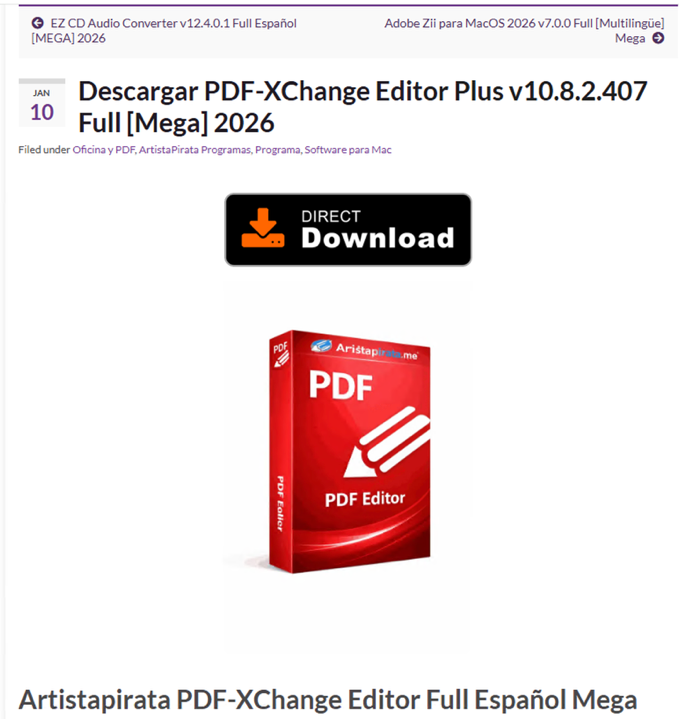
The page of an illegal download link for the cracked software
Clicking the download link triggered a chain of intermediate redirects:
The first redirect was: https[:]//href.li/?https[:]//wikifilhost78.it[.]com/?data=…
This URL uses a public redirector (href.li) combined with a fake file-hosting domain and includes embedded PHP code that generates random values per request, likely to evade detection and complicate tracking.
This was the second redirect: https[:]//getcdn82[.]host93s[.]cfd/?tag=u7tY5vH4
This page acts as a disposable “Downloading…” redirector, using multiple forced redirection methods to immediately forward users to another dynamically generated .cfd domain. This type of behavior is commonly observed in staged malware or phishing delivery chains.
The third redirect was: https[:]//generate907a38[.]host93s[.]cfd/?data=…
Another lightweight redirector forcing navigation to a dynamically generated domain with encoded parameters, reinforcing the pattern of multi-stage obfuscation used to conceal the true payload.
Both domains on this redirection chain were recently registered, indicating that the infrastructure is highly maintained and volatile.
The operational cycle works as follows: piracy advertisements point to a highly configurable redirect link. As URLs are flagged as malicious over time, newly registered domains replace the burned ones. New victims click the piracy ads, get redirected and infected, the links are eventually reported, and the cycle repeats.
Below you can see that even though this domain is fairly new, it’s already flagged in VirusTotal as malicious with a phishing related connection.
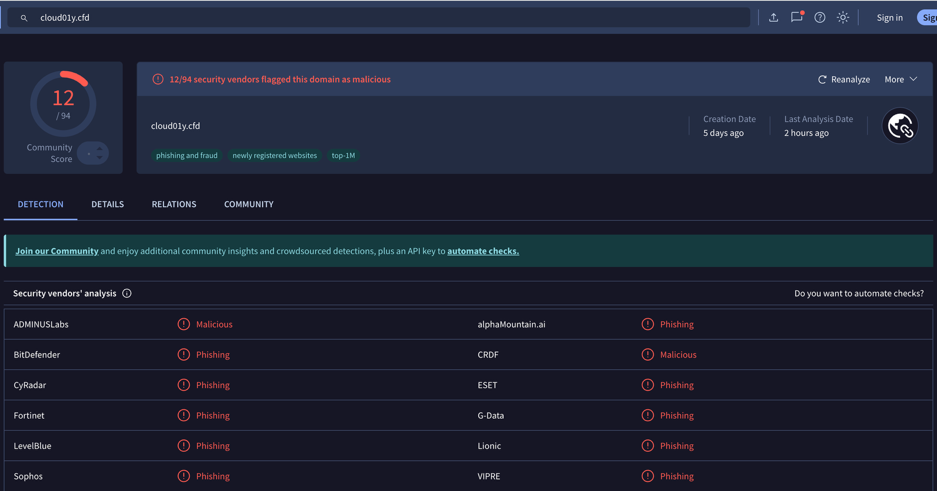
VirusTotal detections for the domain cloud01y.cfd
The backend dynamically generates a new random subdomain for each request to serve the malware.
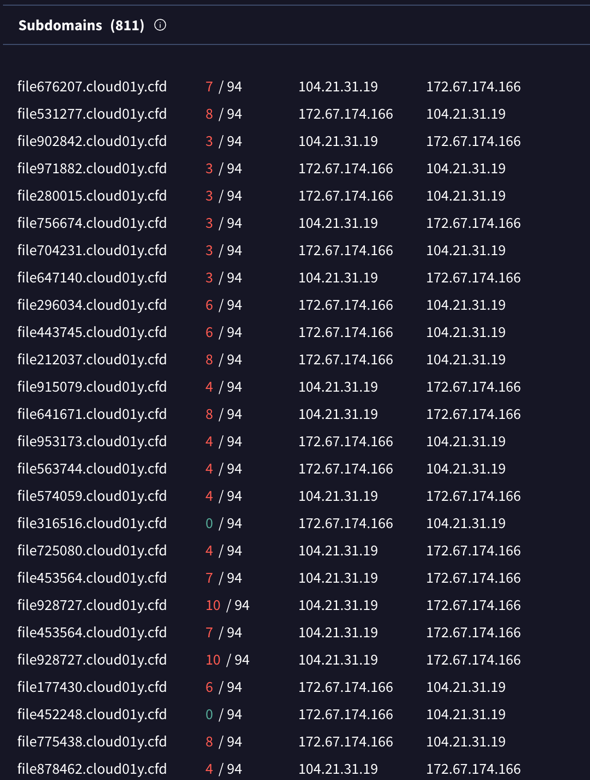
VirusTotal’s (partial) list of sub-domains for our domain
The newly registered domains were:
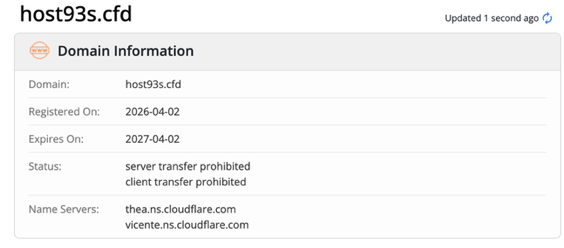
Whois host93s.cfd registration details
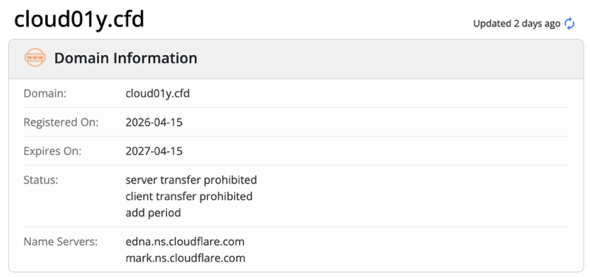
Whois cloud01y.cfd registration details
The .cfd domain is cheap and relatively new, with no established trust. Because it is easy to register and disposable, it is frequently used for short-lived or low-reputation websites. While not all .cfd sites are malicious, they generally carry higher risk compared to established domains.
It is possible that the domain cloud01y is a domain lookalike of the name Cloudly, which bundles several legitimate software companies and an open source project.
Step 3: The Fake Download Page
Below is the final page in the redirect page, which leads to a file download.
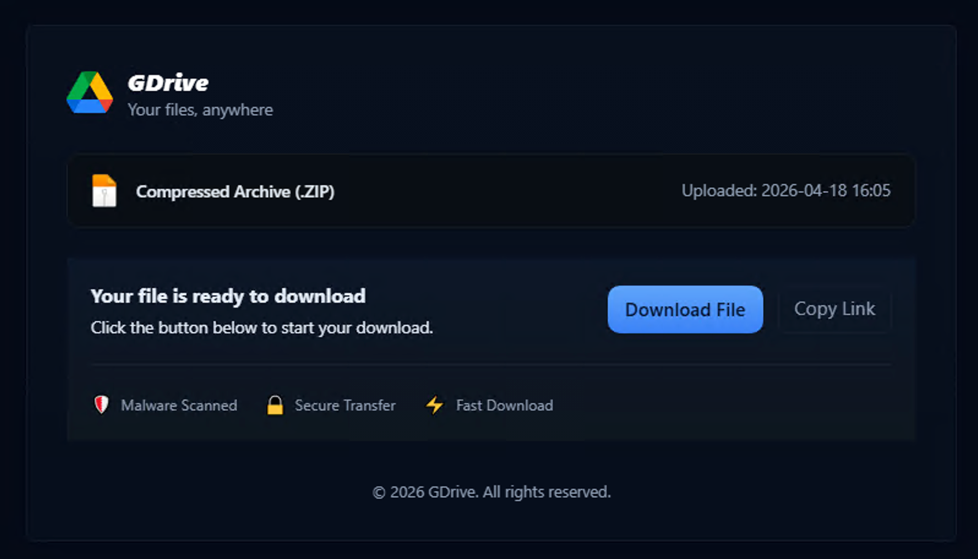
The download site
The final page in the redirect chain presents a fake download interface designed to look like a legitimate cloud storage service (“GDrive”). The actual download link is hidden in the code (data-url=”https[:]//edge2[.]filehost74[.]sbs/…”), while the visible page shows generic trust signals like “Malware Scanned” and “Secure Transfer” that are not backed by any real functionality. The “Copy Link” button is misleading, as it triggers the same download flow instead of copying anything. These pages rotate logos and names of popular file-sharing services such as Google Drive and Dropbox.
The page also includes basic anti-analysis behavior. A script continuously checks whether developer tools are open and, if detected, clears the page content (document.documentElement.innerHTML = ”), which explains why everything disappears during inspection. Additional protections (disabling right-click and text selection) further suggest the page is designed to prevent analysis rather than improve the user experience.
Step 4: The Payload
We downloaded and extracted the compressed .zip file.
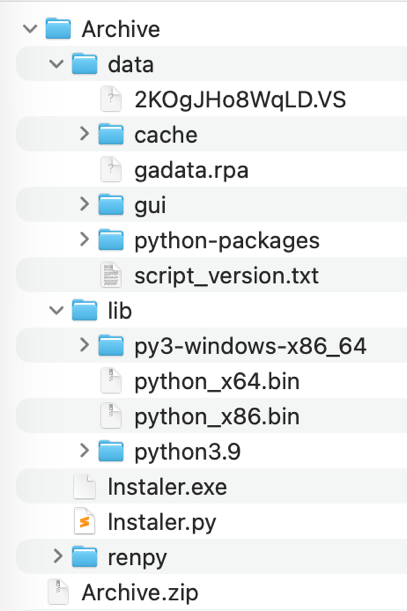
The .zip file inflated directory tree
We analyzed all the files in the inflated directory. Most of them were benign. But, we did find a HijackLoader (also known as Rugmi or IDAT Loader) infection chain delivered via the fake pirated software lure.
The attack uses DLL search-order hijacking: a legitimate, code-signed Valve Steam binary is renamed and bundled alongside a trojanized SDL3.dll that implements the HijackLoader malware.
When the victim executes the fake Steam binary, Windows automatically loads the malicious SDL3.dll from the same directory. The loader reads an encrypted PE payload from a disguised configuration file (mesh.conf) using a 1,002-byte key from asset32.tmp, decrypts it in memory, and reflectively executes the second stage. Based on the delivery context and behavioral indicators, the final payload is most likely Lumma Stealer.
Two of the five files received AV detections on VirusTotal (Rising AV):
| File | MD5 | Detection |
| SDL3.dll | 9af16f9fc35ce00688c20318e868664a | Downloader.Rugmi/x64!1.134BF |
| mesh.conf | 9eecf800853672a56fc46d26b6fa5bb1 | Trojan.HijackLoader!1.12810 |
The same loader is tracked in the media under 3 different names: IDAT Loader, HijackLoader, and Rugmi. It is a private loader sold on underground cybercrime forums. Different threat actors purchase access and configure their own payload and C2.
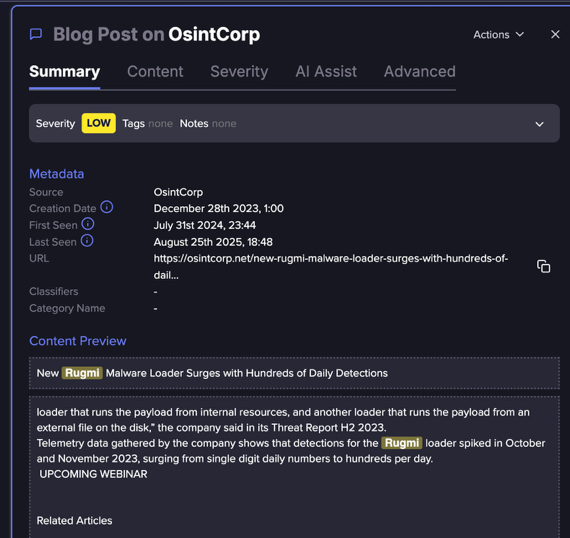
Intelligence on Rugmi loader from Flare (Flare link to post, sign up for the free trial to access if you aren’t already a customer)
In this case, the distribution vector was a fake pirated software forum. Other common distribution methods for this loader include:
- Fake pirated software / game cracks on torrent sites and warez forums
- Malvertising via Google or Bing ads for cracked software
- Fake YouTube tutorials with malicious download links in descriptions
- Telegram channels distributing “free” game cheats and mods
- ClickFix attacks, a social engineering attack where a fake error or CAPTCHA tricks users into running commands on their own device, effectively executing malware themselves (it bypasses traditional defenses by relying on user actions instead of exploiting software vulnerabilities)
Below is the infection chain:
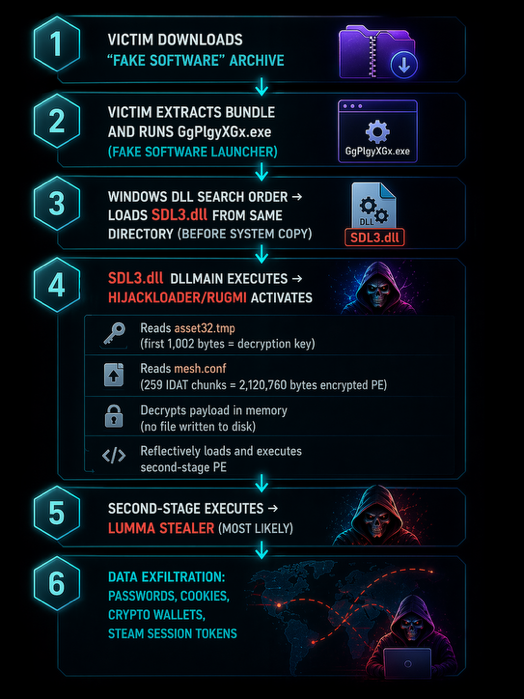
The infostealer’s infection chain
MITRE ATT&CK Mapping
| Technique | ID | Description |
|---|---|---|
| Supply Chain Compromise: Compromise Software Supply Chain | T1195.002 | There is correlation to Phishing, Drive-by-Compromise, and SSC. This is a website that offers cracked software, and introduces malware in the cracked illegal software. |
| User Execution: Malicious File | T1204.002 | Victim runs GgPIgyXGx.exe |
| DLL Side-Loading | T1574.002 | SDL3.dll loaded by legitimate Steam binary from same directory |
| Obfuscated Files: Steganography | T1027.003 | Second-stage PE hidden inside PNG IDAT chunks in mesh.conf |
| Obfuscated Files: Encoding | T1027 | Text-scrambled key (asset32.tmp) and C2 config (mesh.conf header) |
| Reflective Code Loading | T1620 | In-memory PE loading — no disk write of decrypted payload |
| Masquerading | T1036 | steam.exe renamed to random filename GgPIgyXGx.exe |
| Indicator Removal | T1070 | No registry persistence; payload never written to disk |
| Obfuscated Files: API Hashing | T1027.007 | GetProcAddress-by-hash, custom seed 0x0BB7A699 |
| Credentials from Web Browsers | T1555.003 | Expected Lumma Stealer target (browser password stores) |
| Clipboard Data | T1115 | Typical Lumma Stealer collection target |
| Exfiltration over C2 Channel | T1041 | Stealer exfiltrates via C2 encoded in mesh.conf config header |
Taking the Infostealer Malware Seriously with Proactive Visibility
Flare’s analysis reveals consistent and largely opportunistic exposure of credentials linked to FIFA domains, driven primarily by widespread infostealer infections rather than a coordinated, targeted campaign. However, this should not be mistaken for low risk.
The aggregation of hundreds of credentials and nearly 130,000 infostealer logs (from a period of 10 days) creates a fertile ground for threat actors to identify high-value accounts, reuse access across services, and potentially pivot into sensitive environments.
As the World Cup approaches, the risk is not just in an isolated account compromise but in the compounding effect of scale, where stolen credentials, session tokens, and device data can be weaponized for fraud, phishing, lateral movement, and even disruption of event-related operations.
In a landscape where personal and organizational identities are deeply intertwined, infostealers transform everyday infections into strategic footholds. For organizations involved in global events like FIFA, proactive visibility into exposed assets is no longer optional. It is a critical layer of defense.
Detect Exposed Credentials Before They’re Weaponized
Flare continuously scans underground forums, marketplaces, Telegram channels, and combolists to identify compromised accounts tied to your corporate domains, enabling immediate remediation before credentials are traded, reused, or leveraged for lateral movement.