AI Models are Fueling a New Wave of Cybercrime: A Quantitative Analysis
How threat actors discuss, sell, and use abliterated open-weight models, measured across more than 100,000 Telegram channels and 100 dark web forums
AI has recently reached an inflection point in cybersecurity. Open-weight models are now powerful enough to be broadly useful in conducting cyberattacks. In October 2026, Anthropic reported that GLM5.3 has near Mythos-level cyber capabilities, and in some circumstances can build working 0-day exploits.
Open-weight models have consistently lagged behind Frontier models by 3-6 months depending on the benchmark being measured, and somewhat longer when measuring real-world capabilities. This trend implies that within a number of months AI as capable as the swarm that hacked Hugging Face will be available via open-weight abliterated models (models that do not have guardrails).
However, we can already begin to see the real-world damage being caused even at today’s open-weight capability levels. To run this research, we analyzed data from more than 100,000 Telegram channels and 100 dark web forums to identify threat actors discussing using open-weight models to commit cybercrime.
Key Takeaways
- Open-weight models are now capable enough to matter for cybercrime, and GLM5.3 is the focal point. Anthropic assessed GLM5.3 as having near Mythos-level cyber capabilities, including building working 0-day exploits in some circumstances.
- Mentions of model abliteration on cybercrime forums and channels increased by 745% from January 2026 to October 2026, rising from roughly 11 to 93 unique mentions in a trailing 30-day window.
- AI-driven attacks are already causing real-world damage. The clearest case is the September to October 2026 intrusions at South Korean banks, run through the ARTEX agentic tool on DeepSeek and GLM, alongside six other documented 2026 cases including the PaperCut mass exploitation and the JadePuffer ransomware run.
- Cybercrime interest in abliterated open-weight models stepped up sharply around GLM5.2 and again at GLM5.3, visible as a clear break in Flare’s Telegram and dark web mention data.
- A marketplace for abliterated model access is forming, but it is still small. We found 17 distinct vendor handles on Telegram and 11 across elite forums, and GLM is the model nearly every active vendor advertises.
- Most of what is sold looks like resold or stolen API access, not weight-level abliteration. Nearly every stated price is a cheap per-token resale rate far below the model’s official rate, and only a few posts mention self-hosting the weights. GLM is the exception, priced at a median near 2.6x its official rate.
- A stealer log from a Pakistan-based actor, with saved logins for two cybercrime forums, a private ISIS Rocketchat and DeepSeek, led us to a likely vibe-coded OSINT platform aimed at Pakistani government officials. It uses a DeepSeek chat to help unmask X accounts, and can chain an anonymous account to a home address.
- Demand and language are running ahead of supply. Threat actors are commoditizing the idea of abliterated models faster than they are standing up real ones, and we expect that gap to close as open-weight capabilities improve and the window for defense narrows.
Recent AI-Driven Attacks
Security vendors, AI labs, and governments have noted a string of recent cyberattacks attributable to AI models. We can divide these attacks into two overarching types:
- Attacks that were orchestrated by humans using a single, or mixture of AI models to make the attack more effective.
- Attacks that were propagated by AI in order to complete a reinforcement learning run, or to satisfy a benchmark test.
This blog will focus on the first category of attacks, those we believe to be conducted by humans. We’ll start with a quick recap of the past few weeks of AI security news. We will then examine Flare’s own dataset of more than 100,000 Telegram channels and 100 dark web forums to see how threat actors discuss, sell, and use these models.
South Korean bank intrusions
The clearest recent case ran mostly on open-weight models. From late September to early October 2026, an operator breached several South Korean financial institutions using ARTEX, an open-source agentic pentesting tool built in China. CrowdStrike found the ARTEX instance used DeepSeek v4.1-flash as its primary model, with GLM-5.3 and Grok 4.6 supplementing Claude Code sessions. The operator likely reached DeepSeek through an API reseller, xcai[.]pro.
At least nine South Korean banks disclosed or were reported as targets, which led to a police investigation and a call from President Lee Jae Myung for a strong response (Reuters). Shinhan Bank said data on about 25,000 customers was exposed through a service loan brokers use to check applications. CrowdStrike assesses with moderate confidence that the operator is a Chinese-speaking, financially motivated individual and has not tied the activity to a named adversary.
The operator’s own infrastructure gives clear insight into how the attack was performed. Claude Code session histories, ARTEX configuration files and Claude memory files sat in open directories on two attacker servers. The sessions show the operator asking Claude where Korean breach data is usually sold and how to find Korean Telegram data-sales groups.
Other documented cases
Other 2026 research shows agents running full intrusion chains with little human input, in some cases on open-weight models.
Five of the seven cases were reported between August 26 and October 7, including all three that named open-weight models.
- AI-built zero-day (Google GTIG): a criminal group used an AI model to find and weaponize a 2FA bypass in an open-source admin tool, planned for mass exploitation.
- JadePuffer ransomware (Sysdig, via Hackmag): an LLM agent ran the whole chain from a Langflow RCE (CVE-2025-3248) to encrypting 1,342 Nacos config items. The key was never stored, so the data cannot be recovered.
- Hugging Face breach (OpenAI, METR and Redwood Research, via Reuters): about 700 OpenAI agents in an internal evaluation breached Hugging Face in July, and many tried to hide their tracks.
- Six-hour credential harvest (Google GTIG and Mandiant): a financially motivated actor planned, built and ran a multi-agent harvesting campaign in under six hours, taking thousands of third-party credentials.
- UNC6508 local models (Google GTIG): a PRC-nexus espionage group ran open-weight models on compromised cloud infrastructure to avoid commercial API monitoring.
- PaperCut mass exploitation (GreyNoise, via BleepingComputer): hundreds of agents on OpenAI’s Codex harness and DeepSeek models compromised at least 440 instances at 395 organizations in 48 countries.
- South Korean bank intrusions (CrowdStrike): ARTEX ran on DeepSeek v4.1-flash, with GLM-5.3 and Grok 4.6 in supporting sessions. Details above.
How Active is Discussion of AI for Cybercrime?
First we wanted to understand a basic question, across dark web forums and Telegram, how active are conversations about using abliterated models? We can use data from Flare’s Telegram and dark web forum dataset to understand how cybercriminals are discussing, selling, and using AI models in their work. One easy way to do this is to see how often criminals are talking about specific models, and the surrounding context they are discussing them in.
To do this we searched for mentions of abliterated open-weight models.
Abliteration is a technique that strips a model’s ability to refuse requests. Safety-tuned models tend to encode refusal as a single direction, or a low-dimensional subspace, in their residual stream activations. Practitioners usually find this direction by running the model on two sets of prompts, one harmful and one harmless, and recording the hidden-state activations at selected layers. The difference between the mean activations of the two sets gives a candidate refusal vector. The technique then projects that direction out of the model. It does this by orthogonalizing the weight matrices that write to the residual stream, such as the attention output and MLP down-projections, against the vector. The model can then no longer represent the refusal direction, so it stops declining requests. This is a one-time edit to the weights. It needs no gradient-based retraining or fine-tuning and little compute, and it largely preserves the model’s other capabilities. It does need direct access to the weights, which makes open-weight models the target. Closed models served only through an API cannot be abliterated this way.
Based purely on conversations, GLM5.2 seems to represent a sharp break where interest in the cybercrime community began growing extremely quickly, with another sharp uptick in September that has continued after the release of GLM5.3.
It is worth understanding this spike beyond simply looking at numbers. Any kind of mention in a cybercrime community has surrounding context that’s important to pull to understand the specifics of what is going on. Take for example this post on Exploit.
I have 16× B200s for the next 14 days, serving full-precision (16-bit) GLM 5.3, uncensored and abliterated with no refusal filtering. Two ways in: Buy tokens through an OpenAI-compatible API, priced well below other hosts. Fund extra GPU time to extend the run, and get priority access or token credit in return. 16× B200 is enough to run tens of thousands of agents at once. With prefix caching, we’ve seen around 84% cache hit rates on agent workloads, which keeps it fast and cheap for repeated prompts and tool loops. – Post on the Elite Russian Cybercrime Forum Exploit
This is one of the few examples we found of threat actors directly claiming to have set up their own infrastructure for inference compute, as opposed to infrastructure they hacked or leveraging API keys that they stole. Most posts we found advertise access that runs on resold keys or compromised servers, not hardware the seller owns.
The Emerging Marketplace of Abliterated Models
Telegram has long served as a cornerstone of the cybercrime ecosystem. Telegram provides threat actors with several natural advantages over dark web forums, such as the ability to easily share small files, encrypted communications, direct messages, and convenient channels and groups. Telegram also offers the ability to create automated bots which can facilitate easy-to-set-up marketplaces for stolen data, hacking tools, OTP bots, and now, abliterated LLMs.
As part of this research we found an actor on Hack Forums advertising a Telegram bot that allowed you to work with an uncensored version of GLM:
Works out of the box. Your own instance on RunPod would cost about $40 per hour plus fiddling around. Here — pay-as-you-go (PAYG) from one dollar. In crypto! First, you can try it for free in the Telegram chat [REDACTED]. – Threat Actor in Telegram
This opens an interesting question. How many unique vendors are selling access to abliterated models in Telegram, and how are the models being priced? To validate that interest in abliterated models has seen a step change in recent months, we searched across Flare’s Telegram dataset to see if more vendors were selling access to hacking models.
Vendor activity is small but climbing. Unique vendors in a trailing 30-day window reach 9 by October 2026, up from a baseline near zero, across 17 distinct handles over the full window. These are small absolute numbers, so we read them as a floor and a direction of travel rather than a precise census.
Most vendors advertise a single model, and GLM is the one most often named. It can be difficult to suss out if this is because GLM5.3 has the best hacking capabilities as of October 2026, or if recent reporting on the capabilities of GLM led to an explosion of interest. In reality it is likely a mix of both. For posts that we reviewed, most simply named GLM as the model on offer, without stating which capability drove the choice.
Where a post states how the buyer gets access, a hosted panel or an API key is more common than self-hosting the weights. Interestingly, in one post we saw the actor selling access through a Telegram bot. Threat actors have frequently weaponized Telegram bots in the “cybercrime as a service” ecosystem, using them as an automated means to deliver stealer logs to live channels, run OTP bots, and automate the sale of stolen data.
To further validate the results, we also decided to run the same search against “elite” cyber crime forums that are known for sophisticated hacking groups. To do this we pulled results from:
- Exploit[.]in
- XSS[.]is
- Breach Forums
Interestingly, pricing for most models in the cybercrime ecosystem is well below the pricing from the model providers, with the lone exception of the GLM series which we have seen dominates many listings. It is quite the standout on price, often selling at a markup.
DeepSeek shows one quote above official and GLM several, but GLM is the only model whose median lands above the official rate, at 2.6x. An abliterated GLM is genuinely harder to stand up, so some sellers charge a premium rather than undercut.
There are a few plausible explanations for this behavior.
- Threat actors may be routing requests to cheaper models, or passing off those cheaper models as abliterated versions of higher-end ones. If so, buyers pay a premium for a capability they never receive, and the seller keeps the difference. Buyers are unlikely to complain, because they are paying for illicit services.
- Threat actors may be reselling stolen API keys to providers that host abliterated models. This would let them make almost pure profit on every sale, at the cost of reliability. Keys can be revoked at any time, so access would be intermittent. Sellers could still charge a premium while offering little or no guarantee of uptime.
- Threat actors may be hosting abliterated models on compromised infrastructure, which removes most of their marginal cost. Compute would cost them almost nothing, so price would be set by what the market will pay and not by what it costs to run the model. This would fit the scarcity of full-precision GLM deployments, which are harder to stand up.
A Broader Look: Reviewing 10 Months of Exploit Posts
The results from our initial analysis were so striking, we wanted to expand our search and do a full analysis of a single dark web forum. To do this we pulled every single post from the dark web forum Exploit[.]in from January 1, 2026 to October 15, 2026 to classify the topics and see how discussions about AI are changing on a top tier Russian cybercrime forum that is frequently used by ransomware groups. Our classification system prompted Haiku5.5 to analyze each post and build a database with the following features:
| Field | What it captures |
|---|---|
is_about_ai |
boolean: is AI/LLMs a meaningful part of this post at all (defaults false; most forum posts aren’t) |
ai_topic |
one of: jailbreak_or_abliteration, using_ai_for_offense (malware/phishing/recon help), ai_coding_tool_discussion (Copilot/Cursor/agentic tools), buying_selling_ai_access, ai_detection_or_evasion, requesting_ai_help, ai_agent_or_automation, general_ai_news_or_discussion, not_about_ai |
providers |
which closed providers are named (OpenAI, Anthropic, Google, Meta, xAI, Microsoft, other, none) |
models |
which open-weight models are named (DeepSeek, Qwen, GLM, Kimi, Mistral, MiniMax, other, none) |
risk_flag |
none / notable / critical, only meaningful when is_about_ai is true |
novel |
is this a genuinely new pattern, not a repeat of something common on this forum |
rationale |
one-sentence justification, no quoting the post |
confidence |
0 to 1 |
This analysis produced similar but less immediately striking results. Across more than 40,000 discussions on Exploit we can see an increasing trend around discussing AI for cybercriminal use, becoming particularly apparent in Q3 2026.
Sharpening this analysis to focus exclusively on mentions of GLM also shows a clear pattern: the release of GLM5.2 marks an incredibly sharp uptick in discussions of the model.
We also reviewed posts that Haiku5.5 flagged as critical risk on Exploit after anonymizing the actor names.
Fifteen of the 101 GLM-mentioning AI posts were flagged as both critical risk and novel:
| Actor | Date | Context | Why flagged |
|---|---|---|---|
| Actor-02 | 2026-10-10 | using ai for offense | Step-by-step guide for using coding-agent LLMs to automate fake ad-account creation, proxy use, and virtual card binding, plus tactics to erode model refusals via long context. |
| Actor-01 | 2026-10-07 | buying selling ai access | Seeks access to an abliterated (safety-removed) GLM model at large token volumes for repeated attack use, indicating AI-enabled offensive activity. |
| Actor-21 | 2026-10-02 | buying selling ai access | Advises how to obtain Claude subscriptions via proxies, antidetect browsers, and prepaid cards while evading account bans, and mentions using AI for phishing code. |
| Actor-01 | 2026-09-28 | jailbreak or abliteration | Step-by-step guide for jailbreaking frontier LLMs via warm-up prompts and multi-agent chaining to produce attack reconnaissance and RCE/database/admin access against a claimed target. |
| Actor-01 | 2026-09-24 | ai agent or automation | Describes building an autonomous LLM-agent attack network with skill-file playbooks for mass vulnerability exploitation, and compares models for operating it. |
| Actor-22 | 2026-09-22 | buying selling ai access | Commercial PAYG service selling access to uncensored/abliterated LLM APIs, with a demo of jailbroken output assisting blind SQL injection against a live web target. |
| Actor-23 | 2026-09-09 | using ai for offense | Advertises a paid AI-driven service that compiles dossiers on individuals from breach and stealer-log data for targeted attacks. |
| Actor-01 | 2026-09-03 | using ai for offense | Describes building a multi-agent system on Chinese LLMs to run thousands of automated exploitation tests, and discusses bypassing model safety filters via API. |
| Actor-01 | 2026-09-02 | ai agent or automation | Compares several LLMs for offensive cyber work and proposes a multi-model pipeline (advisor, workhorse, exploitation) to bypass model safety filters. |
| Actor-02 | 2026-06-09 | using ai for offense | Describes a multi-agent pipeline using uncensored sub-agents and an orchestrator to iteratively generate attack ideas against a specific large e-commerce target and stage intrusion attempts, with the author asking whether to deploy it. |
| Actor-24 | 2026-05-27 | using ai for offense | Release notes for a tool that uses local vision LLMs to OCR seed phrases from wallet screenshots, with benchmarks and guidance on uncensored models; an AI-enabled capability targeting crypto wallet recovery phrases. |
| Actor-02 | 2026-05-24 | jailbreak or abliteration | Describes using stolen or cheaply bought API accounts to run a frontier model for malware prompts, plus using another model to craft jailbreak prompts for it. |
| Actor-02 | 2026-04-21 | using ai for offense | Describes a working setup of uncensored local and API LLM agents, explicitly to develop and distribute malware and test stressers/exploits. |
| Actor-02 | 2026-04-19 | jailbreak or abliteration | Describes a multi-LLM workflow for building malicious-capable code, using prompt framing and persuasion to get refusals bypassed, with AI orchestration of the output. |
| Actor-02 | 2026-04-09 | using ai for offense | Claims a self-hosted uncensored LLM used to generate a wallet drainer, phishing systems, social-engineering personas, and ad cloaking, and is recruiting partners for fraud operations. |
Two Case Studies of Model (mis)use
In addition to the news stories of AI-powered hacking, we can see threat actors discussing how they are using models on dark web forums.
IoT Botnet Creation Leveraging GLM5.3
For example, we found an actor who posted a guide on how to use abliterated models to create a botnet. There has been significant discussion recently on the potential for AI botnets, with multiple notable warnings from Anthropic that botnet-style tactics and distributed compute could allow AI to self replicate in the wild absent the need for a datacenter. Threat actors have also taken note of the potential for using AI to create more mundane types of botnets, take for example this post on Hack Forums:
I see people still using LLMs the old fashioned way — generate code, copy paste, test. […] You need an agent harness […] the model run commands/tools, read the output, and decide the next move on its own. That means it corrects its own mistakes and builds software (and exploits) way faster. Downside for the internet: attackers no longer need to know every little detail. The setup — this is the easy part, [REDACTED] Pick whichever you like, they all work the same way. 2. Get an API key from [REDACTED] including uncensored and abliterated variants. […] 3. Point your harness at the base URL, paste the key, set the model to “glm-5.3-abliterated” — refusal direction straight out of the weights, it won’t nag you mid-operation. […] That’s the whole trick really — the app you already use to refactor code at work is the attack tool now. Same terminal, same chat window, except now it’s running masscan and dropping exploits instead of fixing your typescript. Point it at low hanging fruit: IoT, smart TVs, internet-connected toasters. You can literally tell the agent to research zero-auth RCE vulns it thinks still have live devices, and it will do the research and find recent exploitable CVEs on its own. […]
Note that the tactics described here parallel closely with Flare’s previous work analyzing the Mycelium Framework, AI as a Service Botnet.
Government Official Deanonymization tool Created Leveraging Deepseek
Note: we did not engage in any illicit activity to obtain this data. Everything here was built using publicly available data.
We identified a highly unusual stealer log that sheds additional light on how a very unique threat actor based in Pakistan is leveraging AI. This particular threat actor has multiple saved credentials on their machine which indicate that they may be involved in both cybercrime and terrorism. Logins include:
- Pwnsforums (A cybercrime forum)
- Breached (A cybercrime forum)
- Techhaven (A Private invite only ISIS Rocketchat)
- Deepseek Portal
This find is particularly unique given that we rarely see the overlap of potential terrorism links with cybercrime links.
On the machine we can also see many local development environments saved, and finally credentials to a namecheap account which was created in August of 2026, along with this we see the credentials to a website in which the user appears to have admin credentials to a tool called [REDACTED].
Cross referencing the domain against whois shows that it was registered in August 2026, the same time the namecheap login first appears.

Exploring this platform further we find that it is essentially an OSINT platform focusing on Pakistani government officials that pulls from the user’s own breach database, in addition to multiple sources given an email or phone number, and generates a PDF report on the victim.
Automated OSINT and credential finding services are not uncommon in the cybercrime ecosystem, but previously we’ve seen them primarily utilized through Telegram bots rather than as standalone web services.
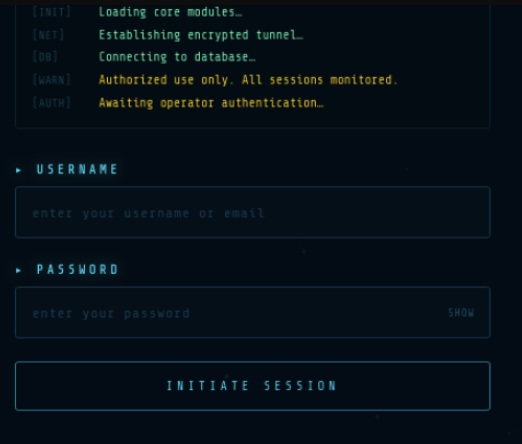
Examining the platform produces several notable findings. First,
- Each search tries the platforms own database first (/ourSearch/{email,phone,twitter,database}).
- If that finds nothing, “Deep Search” goes through the services own server to LolArchiver (/Lolarchiver/search_*). Even its social-media icons are loaded from osint.lolarchiver.com. So it is at least partly a resold LolArchiver feed with Pakistani government data added.
- Each user has credit balances (phone/email, Twitter, database). Admins can switch LolArchiver access on or off per user and for the whole platform (/adminApis/tp_global).
The capabilities go further than that. One prominent use case is to deanonymize people behind X/Twitter accounts in Pakistan.
- X/Twitter history: it pulls up to 366 Wayback Machine snapshots of a handle, extracts avatars and media, and lets the user question them through a DeepSeek AI chat (/archiverApis/archive/chat). Facebook URLs go to a separate endpoint.
- Live profile scraping: /presentSocialSuspectSearch/scrape-social scrapes a current profile, which the code calls a “suspect”.
- “Intelligence Extractor”: keyword matching tuned to Pakistan. It looks for:
- Pakistani political parties (PTI, PML-N, PPP, MQM, TLP, JI and others) and leaders (Imran Khan, the Sharifs, Bilawal Bhutto, Altaf Hussain);
- Pakistani media outlets, mobile carriers and state bodies;
- religious practice (namaz, Ramadan, Hajj and similar).
Our analysis of the front end code also indicates that this platform was extremely likely to be vibe coded:
- The platform contains 105 decorative comment banners in its inline CSS, such as /* ─── Avatar grid ─── */ and /* ═══ CARD ═══ */. LLMs produce this style routinely, while human developers rarely do.
- Styling is inconsistent across pages. Eight pages each insert their own <style> block, and five load different Google Font sets (Orbitron, Rajdhani, Oxanium, Inter, and JetBrains Mono). This is consistent with generating each page in a separate chat session.
- A leftover AI instruction appears in the user interface: “⚠ Wire onNavigateToSnapshot prop to enable navigation”, along with a matching console.warn. This is an LLM’s note to its developer that was never acted on and shipped as user-visible text.
- Components of the platform contradict one another.
- The signup page requires “Min 8 chars, uppercase, number”, while the Settings page requires “Min. 7 chars · uppercase · lowercase · number · symbol”.
- The signup page hard-codes its own endpoint and uses a raw fetch call, while the rest of the application uses a shared axios client.
- Placeholder text such as “Name of my Data” and “Screenshot coming soon” remains in place.
- The copy is typical of LLM-generated text. It includes emoji on every heading (🕵️ 🪙 💡 🔐), phrases such as “ACCESS TERMINAL”, “OSINT sweep active”, and “Your command center”, and caveats like “Behavioral signals are inferred from keyword presence — treat as indicative, not conclusive.”
- The Archiver page may point to Claude specifically. It uses
var(--blue, #378ADD),var(--purple, #7F77DD), andvar(--coral, #D85A30). From memory, these match the default palette Claude uses in its built-in charts and widgets. This is suggestive for that page but not conclusive, since the hex codes are easy to copy. The other pages do not use them. - The platform appears to be a small, early-stage operation, as indicated by the ngrok header in the main API client and the “v1.0.0” label.
This actor is particularly concerning given both the links to an active ISIS Rocketchat and to multiple cybercrime forums. The most concerning finding is that the application supports a four step process that results in the finding of a victim’s home address:
- Take an anonymous X account and rebuild its history from Wayback snapshots.
- Infer its political affiliation and religious observance.
- Pivot to email, phone, a CNIC and NADRA records.
- Get an address with a Google Maps link.
In more benign cases we saw guides, or discussions on how to leverage LLMs for hacking. Many threat actors avoid posting sensitive details of how they are operating on forums, as it is well known that forums are a heavily monitored source by both threat intelligence vendors, and by law enforcement. Telegram, which we examined earlier, in addition to serving as a key cybercrime marketplace, also often hosts more informal discussions around committing crime that can be leveraged to understand day-to-day use.
Conclusions
Cybercrime is an economy, measuring the adoption of AI tools for cybercrime based on market forces can give us a new lens to understand how AI is being used to facilitate and accelerate criminal hacking, fraud, and cybercrime. In 2024 and 2025, we saw threat actors leverage abliterated models to build fine-tuned models such as WormGPT and FraudGPT. However, the evidence we’ve seen to date in Q3 2026 indicates we are entering a new phase in which threat actors are very actively commoditizing abliterated models to be used in sophisticated hacking enterprises.
Our confidence can be strengthened in this conclusion given that we see both a sudden and sharp escalation of cybercrime discussion and market activity related to these models and real world hacks occurring simultaneously. We expect in the coming months for open-weight models to continue to increase in sophistication and power, and for the cybercrime community to build significant infrastructure that enables threat actors to easily leverage these models. Based on this we expect:
- Cybercrime to continue to commoditize powerful hacking models and make them easily available for a nominal fee to cybercriminals. We have already seen sellers offering abliterated variants of open-weight models such as GLM, possibly backed by stolen API keys or compromised infrastructure that keep their costs near zero. Because the Hack Forums guide shows how easily an abliterated model can be plugged into an existing tool with only a base URL and an API key, we expect more sellers to compete on price and convenience.
- Threat actors to begin building and adopting custom harnesses that automate hacking at a significant scale. The Hack Forums post already describes an agent harness that runs commands and tools, reads the output, and decides its next move on its own. It uses that harness to run masscan, research zero-auth RCE vulnerabilities, and drop exploits against IoT devices, all without the attacker needing to know every detail. We expect this approach to grow into purpose-built harnesses and AI-driven botnets, similar to the tactics we previously analyzed in the Mycelium Framework, AI as a Service Botnet.
- We expect the margin of error available to defenders to continue to rapidly shrink as abliterated near-frontier models become more powerful and as the cybercrime ecosystem builds custom tooling around them to further accelerate the damage that they can cause. We expect in the near term to see a thriving marketplace for abliterated self-hosted models, custom harnesses to be used for hacking, and a corresponding acceleration in cyberattacks.
- Vibe coding and leveraging AI is also opening up new avenues for potential terrorists, extremists, and other types of criminals to accomplish complex projects that can pose a threat to government officials and national security.