

By Adrian Cheek, Senior Cybercrime Researcher
On December 29, 2025, an attacker shut down a steam turbine and the process-water treatment system at a combined heat and power plant in Poland that supplies heat to roughly 50,000 residents. Access came through a network the plant shared with another organization, and not through any internet-facing asset of its own.
CERT Polska published the follow-up investigation on August 8, 2026. The chain it describes is worth stating plainly, because every link in it is a device class that can be counted from the outside. The attacker compromised a FortiGate firewall serving as a VPN concentrator at a wind farm, where the VPN was internet-facing and permitted accounts without multi-factor authentication. From there, the attacker tunneled through a cellular router on the wind farm’s network into a private access point name (APN) operated by the regional distribution system operator. That APN allowed any attached device to reach any other. Scanning it turned up a controller at the CHP plant whose web administration interface was reachable and still carrying default administrator credentials. The attacker enabled SSH on that controller, used it as a bridge into the plant’s operational technology network, spent a week enumerating, and then switched three PLCs into stop mode and password-protected them. No malware was used. No vulnerability was established as the cause. CERT Polska states that, to the best of its knowledge, the use of a private APN to gain access to the OT network was the first instance of this attack vector being observed in a real-world cyberattack. That is the agency’s own characterization, hedged as written, and it is repeated here on that basis.
The wind farm and the plant were separate facilities belonging to separate organizations, and neither of them operated the network that connected them. That condition is the reason we conducted this research. This research asks a narrow, measurable question: how large is the population of devices that occupy the same position in the chain, and what can be established about their configuration without touching them? The answer, from a passive census of 2,474 publicly responding addresses across 71 countries, is that the population is substantial. Of the devices that disclose their authentication state, 77% report it switched off, and they will tell you so if you ask politely. The US has the most permissively configured national population in the dataset.
Headline Metrics
Table 1. Headline census metrics, collection window July 14 – August 13, 2026. These are floor figures. They count only devices that answered a single unsolicited probe on one UDP port during one scan window, from one collection platform. Devices that were powered down, behind carrier NAT, on a private APN, or simply missed by the scanner do not appear.
Key Findings About 2,474 Exposed Industrial Serial Gateways
- Authentication posture is passively observable for this device class. The standard discovery response includes a status field that reports whether device authentication is enabled. This requires no credential testing, no login attempt, and no interaction beyond the probe the scanner already sends.
- Where devices disclose it, authentication is off in more than three quarters of cases. 973 of 1,265 disclosing devices report authentication disabled, a rate of 76.9% (rounded up to 77%). Excluding the single dominant national cluster, the rate is 74.4%, so this is not an artifact of one country.
- The US has the second-highest disabled rate of any country with at least 15 disclosing devices, and the highest among countries with more than 100. 128 of 141 disclosing US devices report authentication disabled, a rate of 91%. Only South Korea is higher, at 96% on about 24 devices.
- 13% of the population is attached to mobile operator networks. 322 devices sit on ASNs belonging to named mobile carriers, and 114 of the 190 cellular gateway models in the census are among them. This is the device class that formed the bridge in the Polish incident, and it can be counted directly.
- These devices deploy as singletons, not as clustered field estates. Address adjacency collapses the host count by only 1.07x on contiguous runs and 1.45x at /24, against 1.52x and 1.81x measured for programmable controllers in prior work. Collapse ratios are a property of the device class and cannot be carried between populations.
- A comparable controller population is three-quarters decoy. In a parallel pull of a major PLC vendor’s US-visible estate, 306 of 408 hosts were tagged as honeypots or hosted in cloud address space. Two distinct simulation templates were identified, one of which is not currently flagged by the collection platform.
- The mitigation currently recommended by US federal guidance is the control that failed. A July 30, 2026 FBI and EPA public service announcement on internet-facing water sector controllers lists a private APN first among five isolated architectures that organizations should consider in order to mitigate unauthorized access to OT via cellular modems. Nine days later CERT Polska published the first known case of that architecture being used as the attack path.
Flare Academy Discord Community
Get the Latest Cybersecurity Research
The Flare Academy Discord is where security practitioners and threat researchers break down findings like this one. Join the conversation and connect with the community working on these issues daily.
Why the Access Layer Is the Right Unit of Measurement
Exposure research in this space has a persistent framing problem. The convention is to count controllers:
- How many are reachable?
- How many respond to an industrial protocol?
- How many run an unpatched firmware?
That framing produces a number, but it measures the wrong object, because in most real intrusions the controller was never the thing exposed.
In the Polish case, nothing about the affected plant was internet-facing. The controller that gave the attacker a foothold was reachable only from inside a carrier’s private data network, and the PLCs that were ultimately stopped were reachable only from inside the plant. A census of exposed PLCs conducted the day before the incident would have returned nothing for that site. Every device that mattered was invisible to external scanning.
What was visible was the access layer: the firewall terminating remote access at one facility, and the cellular router bridging a second network. Both are ordinary IT and connectivity products, not industrial equipment, and both are readable from the outside, and both were working exactly as configured. This is the layer worth counting, because it is the layer that determines whether the invisible half is reachable at all.
Serial device servers sit squarely in this layer. Their function is to place equipment that speaks a serial protocol onto an IP network, which means that by design they sit between a routed network and something that has no concept of authentication, encryption, or session state. A serial device server with no authentication is not a vulnerable device in the conventional sense. It has no CVE, no unpatched component, and no exploit to write. It is a transparent bridge, and anyone who can reach it inherits whatever is on the other side. In the Polish intrusion, seven serial device servers were factory reset, given new passwords, and assigned unreachable addresses in order to obstruct recovery. They were significant enough to be worth destroying.
The Census
Collection ran from July 14 to August 13, 2026 against a single UDP discovery service used by one widely deployed serial device server family. The query is product-scoped rather than port-scoped, which matters: in a parallel exercise, the same population approached through a free-text vendor string returned 431 records of which 114 contained no reference to the product at all. That contamination is discussed in the methodology section at the end, because the mechanism is novel and will affect other researchers.
The result is 2,474 records against 2,474 unique addresses, a one-to-one relationship with no duplication to resolve. Every record carries a product label and an industrial control tag. None is flagged as a honeypot, and none sits in cloud address space. No simulation infrastructure for this device class was identified in the collected data.
The response itself is informative beyond mere presence. It returns the model, a device name in a model-and-serial format, the hardware address, and a status field. Across the census, 2,397 distinct hardware addresses appear against 2,474 records, a ratio of 1.032. That is the closest thing to a true device count that exposure research of this type can produce. Most published figures in this field count banner records or addresses and describe them as devices, which conflates three different things; here the three can be separated and reported honestly.
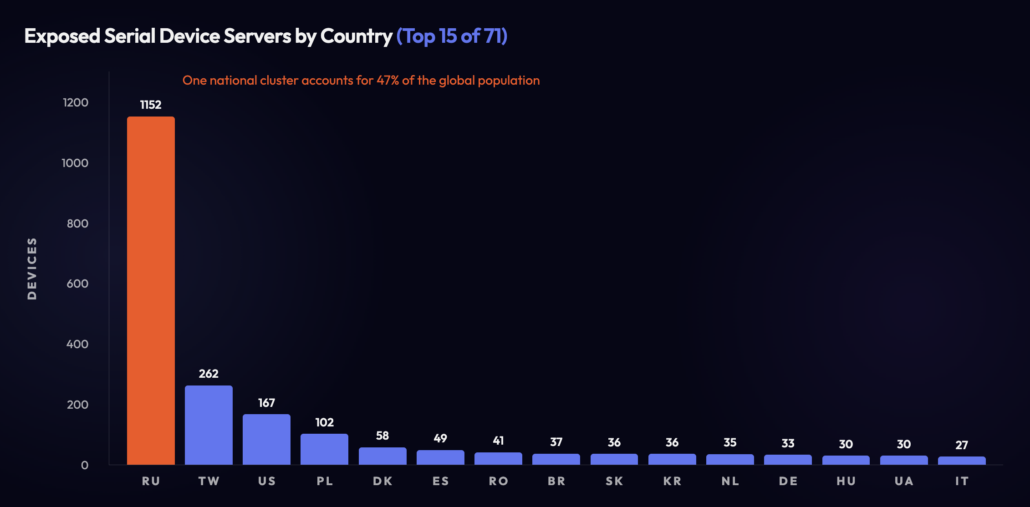
Geographic distribution of the census. One national cluster accounts for 47% of the global population; that cluster is discussed separately below and excluded from the comparative rates reported elsewhere in this paper.
Finding One: Authentication State Is Disclosed, and It Is Mostly Off
The discovery response includes a field reporting whether device authentication is enabled. This measurement is material to interpreting the census, and it is obtained without interaction: the device volunteers it in reply to the same unsolicited probe that establishes that the device exists at all. No login is attempted, no credential is submitted, and nothing is sent that the device was not designed to answer.
1,265 of the 2,474 devices, or 51.1%, populate the field. Of those, 973 report that authentication is disabled. That is 76.9% of devices that answer the question, and 39.3% of the census as a whole.
The distinction between those two figures is important and should not be collapsed. The remaining 1,209 devices report an unknown status, and unknown is not the same as secured. The cause has not been established. Firmware generation and an unresolved device state are both consistent with the observation. The honest construction is therefore a floor and a rate: at minimum 39.3% of observed devices are confirmed to have authentication disabled, and among devices that will say, the rate is 76.9%. Anyone reading a single headline percentage from this work should be reading the second number with the first as its qualifier.
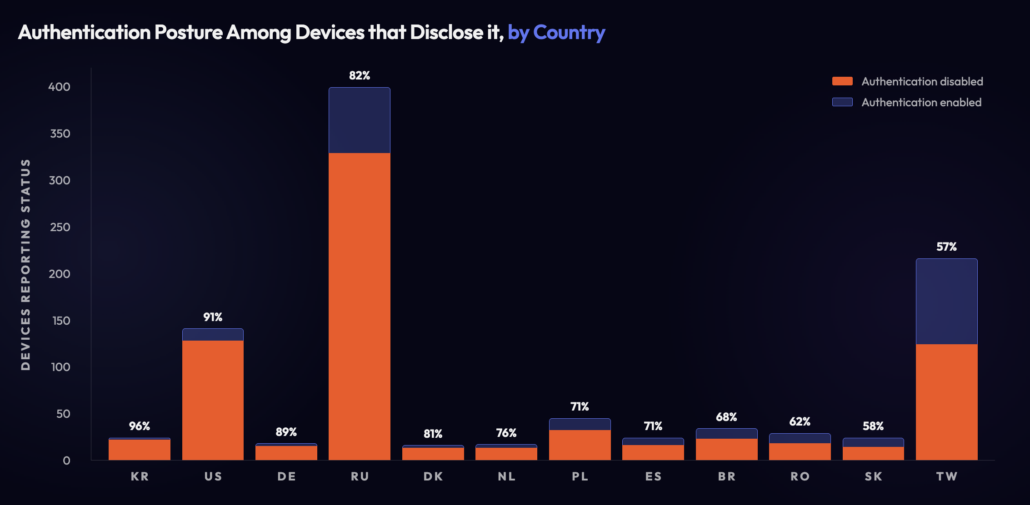
Authentication posture among devices that disclose it, for countries with at least fifteen disclosing devices. Percentages above each bar give the disabled rate for that country.
The rate is not driven by any single geography. Removing the dominant national cluster leaves 1,322 devices, of which 863 disclose status and 642 report authentication disabled, a rate of 74.4% and within three points of the global figure. The behavior is consistent across very different markets, regulatory regimes, and operator types, which is what one would expect if the cause is a shipping default that is rarely revisited rather than a regional practice.
This finding is what converts a device count into a risk statement. The Polish attacker did not need an exploit to cross from the carrier network into the plant: a management interface was reachable and its credentials were the ones it shipped with. A serial device server with authentication disabled presents the same condition in a more permissive form, since there is not even a default password to guess.
Finding Two: The Cellular Bridge Population Can Be Counted Directly
The obvious objection to studying the Polish incident through public scan data is that the critical network, the private APN, is invisible by construction. Devices attached to it sit behind carrier address translation with no public listener, and no amount of internet scanning will enumerate them. That objection is correct, and it is the reason the incident took an eight-month investigation and privileged access to mobile operator logs to reconstruct.
It is also incomplete, because the bridge devices themselves are frequently not invisible. 322 of the 2,474 devices in this census, or 13.0%, sit on address space announced by named mobile network operators. 190 devices in the census belong to the vendor’s cellular gateway product family, and 114 of those are among the mobile-attached group. These are industrial serial gateways, publicly routable, attached to mobile carrier networks, answering a discovery probe from the open internet.
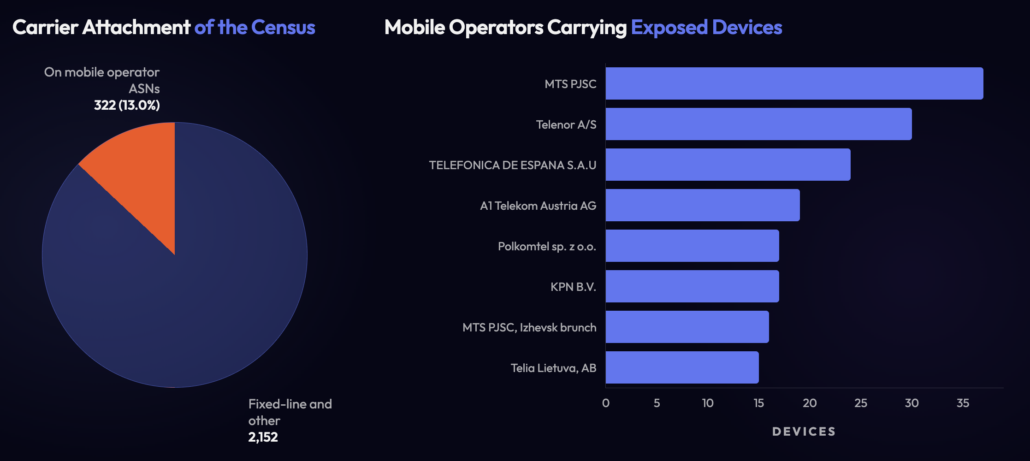
Carrier attachment across the census, and the mobile network operators carrying the largest numbers of exposed devices. Operator names are those published in the routing registry for the announcing autonomous system.
The operators involved are national mobile carriers across Europe, the Middle East, and the Commonwealth of Independent States, including at least one Polish mobile operator carrying seventeen exposed devices. The presence of these devices does not by itself demonstrate that any specific carrier operates a permissive private APN. It demonstrates something narrower and still significant: that industrial serial bridges are routinely deployed on mobile carrier infrastructure, that a measurable number of them are directly reachable, and that the population is large enough to study without needing privileged operator data.
A second device class reinforces the point. In a parallel pull of a major industrial vendor’s US-visible estate, seven industrial cellular and DSL routers appeared in the clean, non-decoy remainder: five LTE units on two national US mobile carriers and two DSL units on a regional fixed-line provider. That is the same functional class as the router that carried the attacker into the private APN in Poland, present in United States carrier address space, visible today.
Finding Three: What This Would Look Like in the US
The conditions that enabled the Polish incident are not unique to European networks, and the reasons are specific. Four conditions had to hold for that attack chain to work. Each can be checked against US data, though only three can be observed directly.
Condition One: an Internet-Facing Remote Access Concentrator at a Distributed Generation Site
The entry point was a firewall acting as a VPN concentrator at a wind farm, exposed to the internet and permitting accounts without multi-factor authentication. This configuration is common in US field estates. Remote access appliances at unstaffed generation and field sites are a standard architecture, and internet-facing SSL VPN portals in US utility and public sector address space have been the subject of federal advisories in their own right. Distributed energy resource sites are particularly exposed to this pattern because they are numerous, unstaffed, operated by asset owners with small or outsourced IT functions, and connected on terms set by whoever they interconnect with.
Condition Two: a Cellular Router Bridging that Site to a Shared Carrier Network
This condition is often assumed to be specific to European connectivity practice. US data indicates otherwise. Our prior research established that the US population of internet-visible programmable controllers is overwhelmingly a cellular population: of 1,512 clean US hosts in a national controller census completed in early August 2026, 74.3% were carried on a single mobile operator’s network. That concentration reflects how remote industrial sites in the United States are connected: by cellular modem, on carrier-managed data plans, and frequently within shared or private APN arrangements sold by the carrier as a managed isolation product.
The same census showed those hosts geolocating to a small number of carrier aggregation points instead of to their physical sites, which is itself evidence of the shared infrastructure that makes lateral movement between unrelated subscribers conceivable. The device classes are present too: this paper’s own data contains industrial cellular gateways on US mobile carrier address space, and the parallel vendor pull contains LTE routers on two national US carriers.
Condition Three: a Permissive Shared Network Between Unrelated Organizations
The critical misconfiguration in Poland was that the distribution operator’s private APN permitted any attached device to communicate with any other. CERT Polska’s post-incident survey found this arrangement common among Polish organizations operating private APNs, and assessed that similar configurations are likely widespread internationally.
Nothing in the available evidence establishes that the United States is an exception. Client isolation on a private APN is an optional feature that must be requested and configured. It is invisible in normal operation, because a permissive APN and an isolated APN behave identically until someone scans one. It has no compliance driver and generates no alert when absent. No external party, including the subscriber, can verify the setting from outside the carrier network.
More directly: on July 30, 2026, the FBI and the EPA issued a joint public service announcement on attacks against internet-facing water sector controllers. To mitigate unauthorized access to OT via cellular modems, it advises organizations to consider isolated architectures, and lists a private APN first among five such options. Nine days later, CERT Polska published its assessment that a private APN had served as the attack path into an OT network for the first time in an observed real-world incident. US operators are being advised, correctly in principle, to adopt a control whose principal failure mode is not characterized in the public evidence, cannot be measured by external scanning, and cannot be verified by the customer from the outside.
Condition Four: an Unauthenticated or Default-Credentialed Device on the Far Side
The census speaks directly to this condition. The US sample in this dataset is 167 devices, of which 141 disclose authentication state. 128 of those report authentication disabled, a rate of 91%. That is the highest rate of any country with at least 15 disclosing devices, behind only South Korea’s much smaller sample, and 16 points above the ex-cluster global average.
The Polish attacker needed a controller carrying default credentials to make the pivot. In the US sample, nine in 10 devices that answer the question report that they are not requesting credentials at all.
Table 2. The four conditions required for the Polish attack chain, assessed against US evidence. Three of the four are directly evidenced in collected data. The fourth is not observable from outside the carrier network, which is a statement about measurement and not about absence.
Three of the four conditions are evidenced in United States data. The fourth cannot be observed from outside the carrier network. The chain in Poland ran on a common connectivity pattern, an unaudited default in a carrier product, and a device that did not request credentials. The US has more of the first, no visibility into the second, and by this measurement a weaker position on the third.
Finding Four: Deployment Shape and the Limits of Host Counts
Address adjacency in this census collapses 2,474 hosts to 2,311 contiguous runs, 2,211 distinct /29 networks, and 1,701 distinct /24 networks, giving ratios of 1.07x, 1.12x and 1.45x respectively. Only 44% of hosts share a /24 with another host in the set.
Prior work on programmable controllers measured 1.52x on contiguous runs and 1.81x at /24, with the figure stable across three independent samples. The difference exceeds the variation observed between samples and reflects a different deployment shape. Controllers cluster because a single site fields several of them behind one connection. Serial device servers appear as singletons because a site typically needs one to bridge whatever serial equipment it has.
The practical consequence is that collapse ratios are a property of the device class and cannot be transferred between populations. Applying a controller-derived ratio to this dataset would understate the number of distinct installations by roughly a quarter. Any research that reports installation estimates should derive the ratio from the population being measured, and should say which of host count, address count, hardware address count, and installation estimate it is reporting.
Finding Five: Comparable Controller Populations Are Mostly Decoy
The serial device server census is unusually clean. A parallel pull of a major industrial vendor’s US-visible estate, conducted over the same window across management and industrial protocol services, was not. Of 408 hosts, 200 carried an explicit honeypot tag and 291 sat in cloud or content delivery address space, with 306 in the union of the two. That leaves 102 hosts, one quarter of the set, as a plausible operational population.
Two distinct simulation templates account for much of the decoy half:
- The first is a well-known open-source industrial honeypot whose default management strings are widely documented and which the collection platform flags reliably.
- The second is not flagged. It comprises 55 hosts sharing an identical, distinctive site-location string and an identical contact string, 46 of them in cloud address space and 26 on a single hyperscale provider, presenting under a controller product label in some cases and under a Python network management library in others. A location string shared by 55 hosts on virtual private server infrastructure is assessed as a single deployment, and a Python network management library appearing as a product label is consistent with a simulated agent and not with an embedded controller.
Researchers publishing counts for this vendor’s estate should exclude both templates. Publishing the unfiltered figure overstates the operational population by roughly a factor of four, and the second template will pass through any filter that relies solely on platform honeypot tagging.
The Dominant National Cluster
Russia accounts for 1,152 of the 2,474 devices, or 47% of the global population. The concentration is not distributed across that country’s industrial base in the way one would expect of an organic estate. The devices sit predominantly on regional consumer and metropolitan broadband providers and not on industrial or utility networks, cluster in a handful of provincial cities, and are dominated by a single embedded serial-to-Ethernet module accounting for 537 of them.
The explanation most consistent with the observed profile is a single original equipment manufacturer product line shipped at volume with the module embedded and its network interface exposed, by way of illustration only, equipment of the building services or metering type sold into a domestic market. No identification of the actual application was made. Whatever the cause, the cluster will dominate any global percentage it is included in, which is why every comparative rate in this paper is also reported with the cluster excluded. Readers should treat the global figures as descriptive and the ex-cluster figures as the basis for inference.
Technique Mapping
The following maps the observed intrusion chain and the census findings to MITRE ATT&CK for ICS. Techniques are marked according to whether the evidence comes from this dataset or from the external incident reporting. A passive census observes preconditions and not adversary execution, so only one technique is dataset-evidenced. No command and control techniques are claimed, because none were observed.
Table 3. Technique mapping. Dataset-evidenced techniques are those directly observable in the collected data. External techniques are drawn from the published incident reporting and are included to show where the census population sits within the chain. Technique identifiers and names were verified against the current MITRE ATT&CK for ICS matrix prior to publication.
Key Judgments
High Confidence
- The exposed serial device server population is majority unauthenticated by configuration. The measurement is self-reported by the device to an unsolicited probe, is consistent across 71 countries, and holds within three percentage points when the dominant national cluster is removed.
- A material fraction of the population is attached to mobile operator networks. 322 devices on named carrier ASNs, including 114 of 190 cellular gateway models, is a direct observation rather than an inference.
Moderate Confidence
- The United States population is more permissively configured than the international average. The rate of 91% is drawn from 141 disclosing devices, which is a sound sample for a proportion but small enough that a single large operator’s practice could move it several points. The comparison is against countries with at least fifteen disclosing devices.
- The conditions that enabled the Polish intrusion are present in the United States. Three of four are directly evidenced. The fourth condition, permissive client-to-client traffic on shared carrier APNs, cannot be observed externally, and its status in US carrier products is unknown rather than established as safe.
- Published counts of the comparable controller estate are inflated by simulation infrastructure. The decoy proportion is measured directly, but the second template is identified by shared configuration strings and not by confirmed provenance.
Low Confidence
- The dominant national cluster represents a single OEM product line and not an industrial estate. The model concentration, carrier profile and city distribution are all consistent with that reading, but no direct evidence of the product or vendor was obtained.
What Security Teams Can Do This Week
- Ask your carrier, in writing, whether client isolation is enabled on your private APN. This question is the one most likely to change an operator’s actual exposure. A permissive APN and an isolated one are indistinguishable from the subscriber side. Do not assume the managed product includes it.
- Enumerate your own serial device servers and check the authentication state. The same discovery service that this census used will answer from inside your network. If the status field reports authentication disabled, that device is a transparent bridge to whatever is on its serial side.
- Treat the carrier network as untrusted from the OT side. Allowlist the specific traffic that must cross between the cellular gateway and the control network, and drop everything else. The Polish plant’s requirement that substation communications run over a serial industrial protocol was met, and made no difference, because the requirement governed the data path and not the management interface of the device carrying it.
- Remove management services from interfaces reachable over the carrier network. SSH and Telnet on the carrier-facing side of a cellular router are what turn a connectivity device into a pivot. In the incident, the tunnel that reached the control network ran over a management service that was working exactly as configured.
- Audit remote access concentrators at unstaffed and third-party-operated sites. The compromised entry point belonged to a different organization than the affected plant. Interconnection partners, generation sites, and contractor-managed facilities are inside the chain whether or not they are inside the audit scope.
- Do not rely on the absence of malware as evidence of the absence of an incident. Every destructive action in the Polish case used a supported device function invoked over the plant’s own protocols. The site initially logged the disruption as probable contractor error.
A False-Positive Mechanism Worth Documenting
A control exercise using a free-text vendor string rather than a product-scoped query returned 431 records, of which 114, or 26%, contained no reference to the product. The mechanism is not the substring collision in encoded data that affects short fingerprint terms. This platform stores banner newlines as the two literal characters backslash and n. A service whose banner contains a line beginning with the word “port” is therefore indexed with those characters immediately preceding it, and a free-text search for a term ending in those same letters matches the resulting token. The affected records were message queue port mappers, building automation services, file synchronization daemons, and a monitoring agent.
The general rule this implies: a free-text fingerprint whose leading characters combine with a preceding escaped newline to complete a common banner-line-initial word (port, name, host, model, serial) will produce false positives that no length heuristic catches. Product-scoped or module-scoped queries avoid the problem entirely.
Flare Academy Discord Community
Get the Latest Cybersecurity Research
The Flare Academy Discord is where security practitioners and threat researchers break down findings like this one. Join the conversation and connect with the community working on these issues daily.
References
- CERT Polska (CSIRT NASK), Follow-Up Analysis of the December 29, 2025 Energy Sector Incident, published August 8, 2026.
- FBI and EPA, Public Service Announcement: Malicious Cyber Actors Targeting Water and Wastewater Sector Internet-Facing Programmable Logic Controllers, Causing Operational Disruptions, July 30, 2026.
- Flare Research, prior publications in this series on programmable controller exposure and adjacency measurement, 2026.