
By Estelle Ruellan, Threat Intelligence Researcher
Over the past five years, more than 110 million stealer logs have changed hands on underground markets. If we take the time to think about it, infections shouldn’t be so high. Billions have been invested in technical defenses, antiviruses are better than ever, browsers warn you, operating systems sandbox and sign. And yet infostealers keep landing at scale, month after month.
The reason is simple: our technical defenses haven’t failed. People are switching them off, often because of the threat actors manipulating them through social engineering, and without understanding what they’re risking.Infostealers don’t hack you, they just ask nicely. Most infections come from social engineering, with malware disguised as cracked software or gaming mods. Victims are often told to disable their antivirus to “install correctly,” opening the door themselves. Technical controls can be socially engineered out of the equation, and that is why infostealers remain so effective.
So what are these lures promising that works so well, driving over a million infections a month?
The answer is in the stealer logs themselves. Many include a screenshot taken at the moment of infection, plus browser history and file listings, which together reveal what the victim thought they were installing. Using an LLM pipeline from our earlier work, we extracted a short lure description from each log, such as “Adobe Photoshop CC 2024 crack multilingual” or “Roblox Solara executor v3.2 free download.”
One lure shows what fooled one person. To see which lures work best, we studied and grouped them into 177 campaigns. That lets us measure which promises succeed, how long they last, how fast they spread, and where defenders can hit them hardest.
Key Findings About Infostealer Malware Lures
- Lures, not exploits, drive infections. Most successful infostealer infections come from social engineering, such as cracked software and game mods that convince users to download them and even disable their antivirus.
- Each brand hides many campaigns. The top 10 brands account for about a third of all infections (18,496 of 53,896), but they aren’t single operations. Looking inside them revealed 177 separate campaigns: 128 targeting software and 49 targeting gaming.
- Gaming campaigns are bigger. Software brands cause more infections overall, (60% of the top 10 brands), but gaming dominates the biggest individual campaigns, accounting for 59% of infections in the top 10.
- Software campaigns are faster. They last a median of 21.5 days and get nearly half (48%) of their infections in the first five days. Gaming campaigns last longer, a median of 27 days, and grow steadily over time.
- Each ecosystem has different pressure points. Gaming campaigns rely on lookalike sites feeding into shared platforms (GitHub in 45% of campaigns, MediaFire and YouTube in about a third each). Software campaigns lean on torrent indexes (40%, with The Pirate Bay alone at 27%).
- Lures are stable. Links and payloads rotate constantly, but the lure stays the same, which makes it the best handle defenders have for tracking and warning users.
Infostealer Exposure Monitoring
Find Out Which Infostealer Lures Are Putting Your Organization at Risk
Infostealers don’t break through your defenses, they talk people out of them. Start a free trial to search stealer logs for infections tied to your employees, customers, and domains, and act before stolen access is used against you.
One Lure, One Campaign
The idea was simple: treat the lure itself as the campaign’s signature. Infections that share the same lure belong to the same campaign. Count the infections in each campaign, and you know which lures are behind the most infections.
But with 54,000 lures, the challenge was scale. The obvious first move was to turn all lures into embeddings and cluster them together. Great idea, right? Well, we did get clusters. Brand clusters.
Campaigns Hide Below Brands
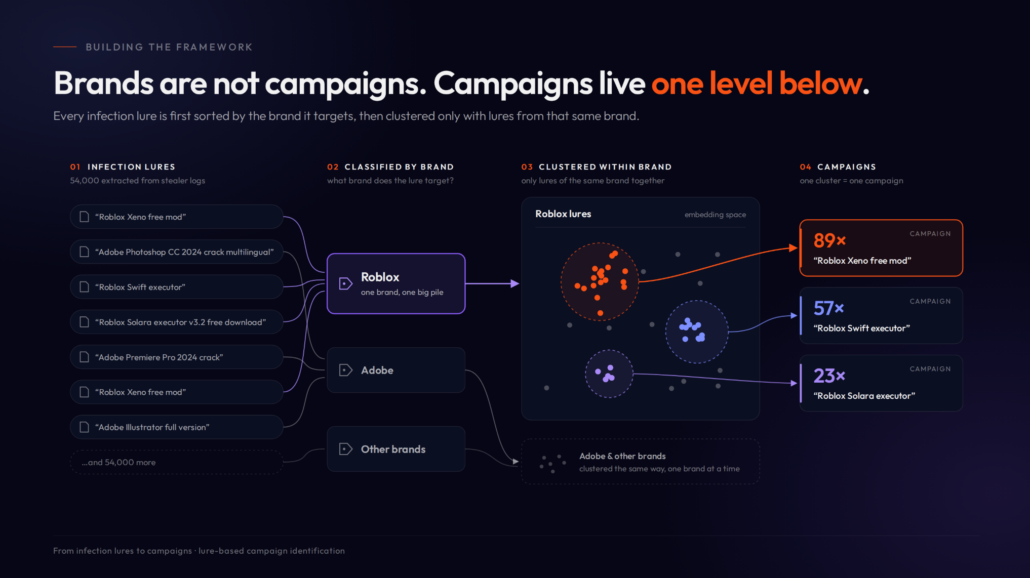
Every Roblox infection ended up in one big pile, and every Adobe infection in another. That sounds close enough, until you look inside a pile. The Roblox cluster alone mixed together very different lures:
- 282 × “Roblox Xeno free mod”
- 138 × “Roblox Swift executor”
- 134 × “Roblox Solara executor”
- …
Each one pointed to its own set of download links, for its own executor or mod. They were three separate campaigns hiding under one brand. That’s when it clicked: campaigns live one level below brands. Knowing the brand was only the starting point.
So instead of clustering everything at once, we first sorted each infection by the brand it targets, then clustered within each brand to surface the actual lures.
Nobody Wants to Pay for a License
Sorting infections by brand got us a “leaderboard” of the brands threat actors impersonated most successfully. Windows activators (KMS) take first place, followed by Grand Theft Auto and Microsoft. Turns out, people really don’t like paying for software licenses.
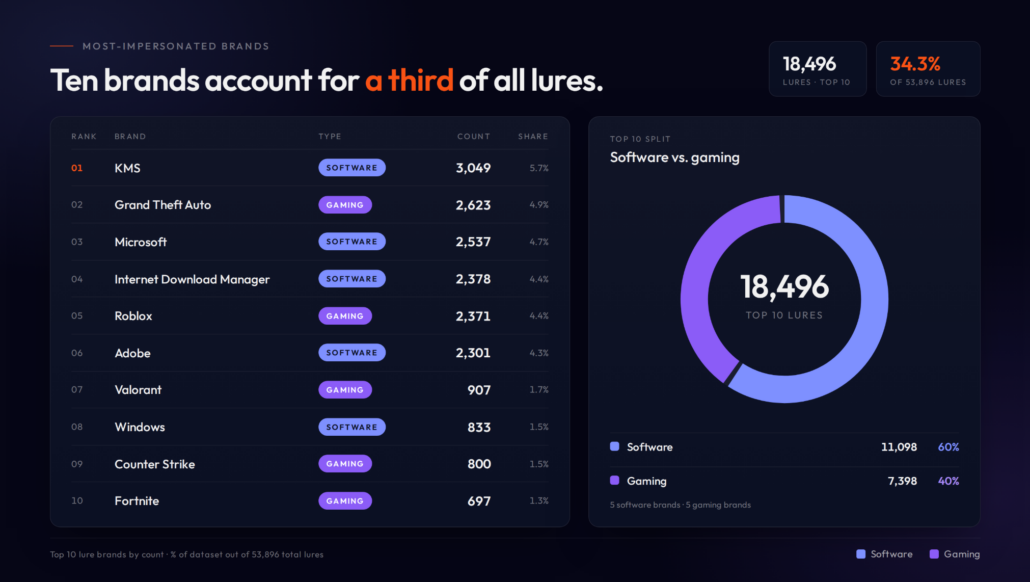
Just 10 brands account for a third of all infections in our dataset: 18,496 out of 53,896. They split neatly into two worlds:
- Software: KMS, Microsoft, Internet Download Manager, Adobe, Windows
- Games: Grand Theft Auto, Roblox, Valorant, Counter-Strike, Fortnite
Software lures bring in the bigger share, 60% of those infections versus 40% for gaming. The top six are in a league of their own, with over 2,300 infections each, before the count drops to under a thousand.
Learn more about the further breakdown of these categories in our earlier research into how threat actors target their infostealer malware victims.
These 10 brands became the playground for everything that follows.
To note: The inclusion of these top brands as infostealer malware lures does not speak to the security posture of these organizations. Threat actors abuse the popularity and name recognition of these tools and games.
Where Clustering Broke: Same Algorithm, Different Results
GTA was the first brand we clustered. The clusters looked solid, and on inspection they turned out to be real campaigns.
Then we clustered a software brand, Adobe, using the exact same algorithm. This time, the clusters were clearly off. Fancy metrics were not needed to see it, reading the lures that were inside clusters was enough. “Adobe Photoshop v25.3.1.122 multilingual,” “Adobe Photoshop v12.8.5,” and “Adobe Photoshop v24.7 crack” were all sitting in the same cluster, even though they were entirely different releases.
The reason is simple: text embeddings are nearly blind to version numbers. They capture meaning, not numbers, so “Photoshop v25.3” and “Photoshop v24.7” look almost identical. For cracked software, though, the version number is exactly what separates one campaign from the next.
Why One Algorithm Wasn’t Enough
The main problem here was that we tried using the same method of clustering for two structurally different lure ecosystems. Gaming campaigns are named after executors or mods with distinctive names like “Solara” or “Azxus,” which stand out from generic words like “free” or “crack.” Clustering alone is enough to separate them.
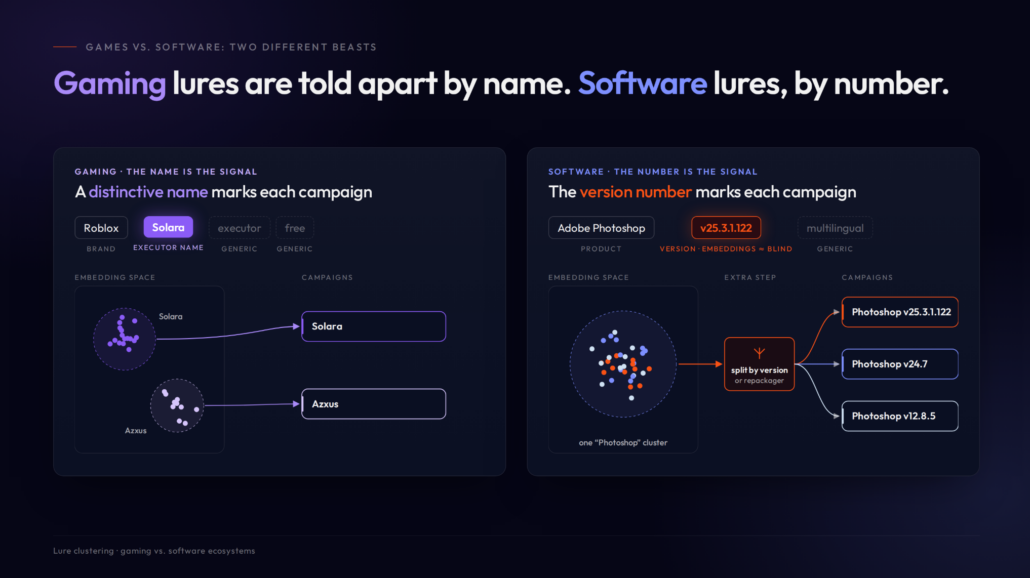
Software needs one more step. The clustering hadn’t failed; it had correctly grouped everything Photoshop together. What was missing was splitting that product cluster into campaigns by version, or by the repackager who signed the crack. That difference between the two ecosystems shaped every design choice in the pipeline. The white paper, Tracking What Works: Social Engineering Lures as Signatures for Victim-Centric Infostealer Campaign Discovery, walks through both forks of the algorithm in detail and evaluation of clustering performance as well.
What We Found
Applied to the 10 most targeted brands in the dataset (18,496 infections), the framework identified 177 campaigns: 128 built around software and 49 around gaming tools.
So, back to our opening question: which lures actually worked? Here are the 10 biggest (the brand of game, e.g., Roblox, is under the name of the lure, e.g., Xeno executor):
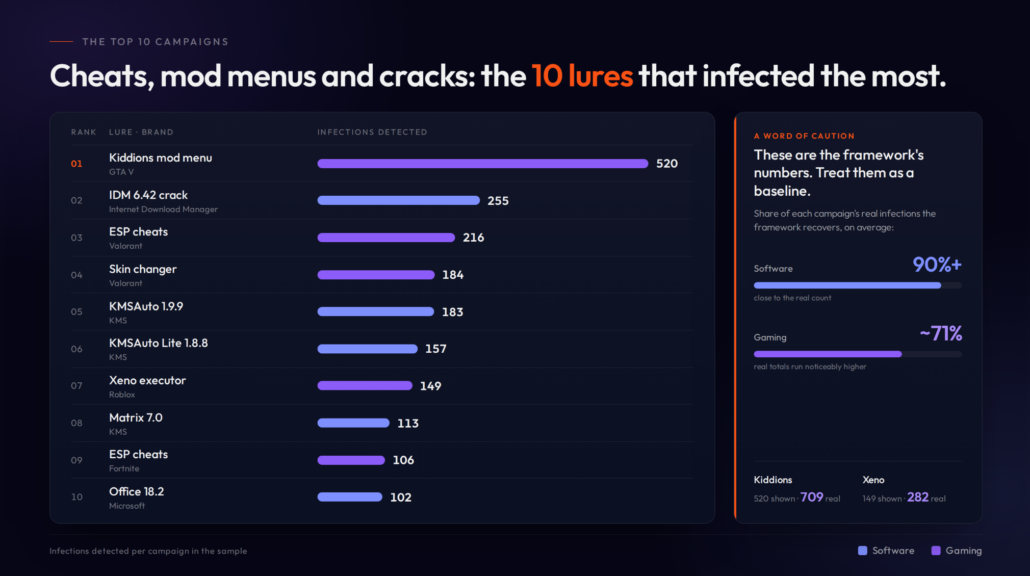
*One caveat: these numbers are a floor, especially for gaming. The framework recovers over 90% of a software campaign’s infections on average, but only about 71% for gaming. So the software ranking is close to reality, while the biggest gaming campaigns are even bigger than they look.
The top 10 is split evenly with five gaming campaigns and five software campaigns. Yet the gaming campaigns account for 59% of the infections. That’s the opposite of what we saw with brands, where software accounted for 60% of infections in the top 10.
How can both be true? It comes down to how many campaigns there are and how big each one is:
- Software: Consists of many small campaigns (128). Each one infects slightly less people, but together they add up to more infections.
- Gaming: Has fewer, bigger campaigns (49). Each one infects more people, but there aren’t enough of them to catch up.
One campaign steals the show: the Kiddions mod menu for GTA V infected 520 people in our sample, twice as many as the runner-up, an IDM crack (255 infections). Continuing with gaming campaigns, Valorant takes two of the top four spots with an ESP cheat campaign and a Skin changer campaign. The Fortnite “ESP cheats” campaign takes the 9th position. This suggests first- and third-person shooting game cheats, whatever the game, are a very successful type of lure.
The promise differs between the two worlds. Gaming lures sell an edge whether it’s a competitive edge (e.g. mod menu, wallhack) or an aesthetic edge (e.g. skin changer, skin swapper). Software lures capitalize on people’s reluctance to pay for licenses. They offer for free the tools everyone needs but nobody wants to pay for: Windows activators, Office, or Internet Download Manager (IDM).
Epidemiology of Infostealer Campaigns
Knowing which lures worked tells us how big these campaigns got, but not how they got there. And the difference in lures turned out to be just the tip of the iceberg: software and gaming campaigns don’t only lure people differently, they also live and spread differently.
How Long Do They Live?
Not very long, it turns out. Across all 177 campaigns, the median campaign lifespan (defined as the time between the first infection and the last observed infection) is 22 days, and even the toughest ones only made it to about 44, at least within our seven-week observation window.
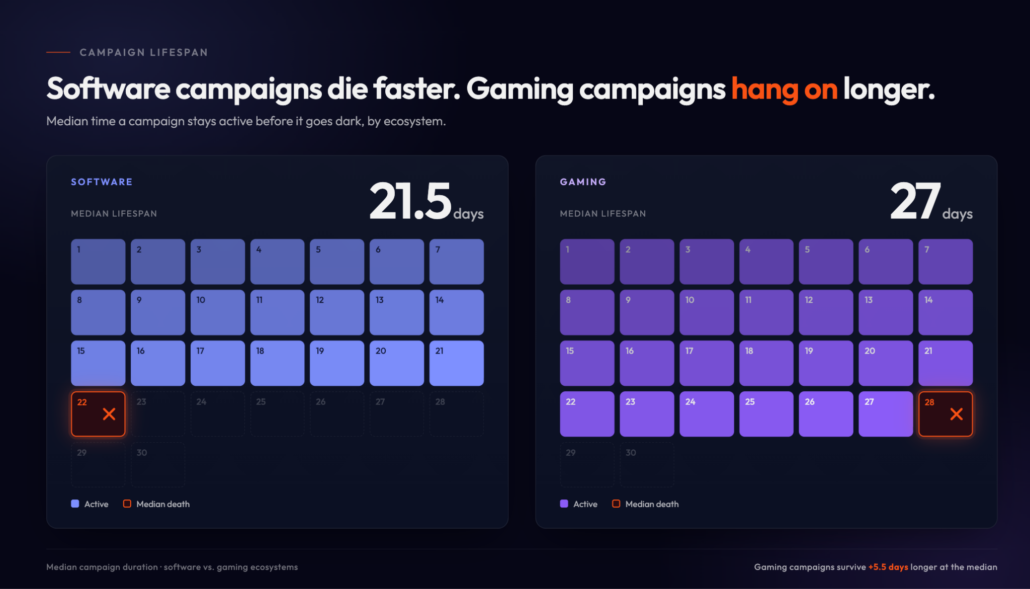
But the two ecosystems don’t age the same way. Software campaigns die faster, with a median of 21.5 days, while gaming campaigns hang on a bit longer, with a median of 27 days, almost reaching a full month. It makes sense once you think about it: a crack is tied to one specific version, so it has an expiration date built in. The moment the software updates, the old crack loses its appeal. A cheat or a mod menu, on the other hand, keeps working for much longer, so there’s no rush to replace it.
How Fast Do They Spread?
Software campaigns are sprinters. They hit hard and early. A new crack drops, many people want it, and infections pour in. On average, a software campaign gets nearly half of its infections (48%) in the first five days and close to two-thirds (64%) by day 10. The shortest campaigns are also the most intense: those that die within a week average over three infections a day. Then demand moves on. A patch comes out, a newer crack shows up, and nobody wants the old version anymore.
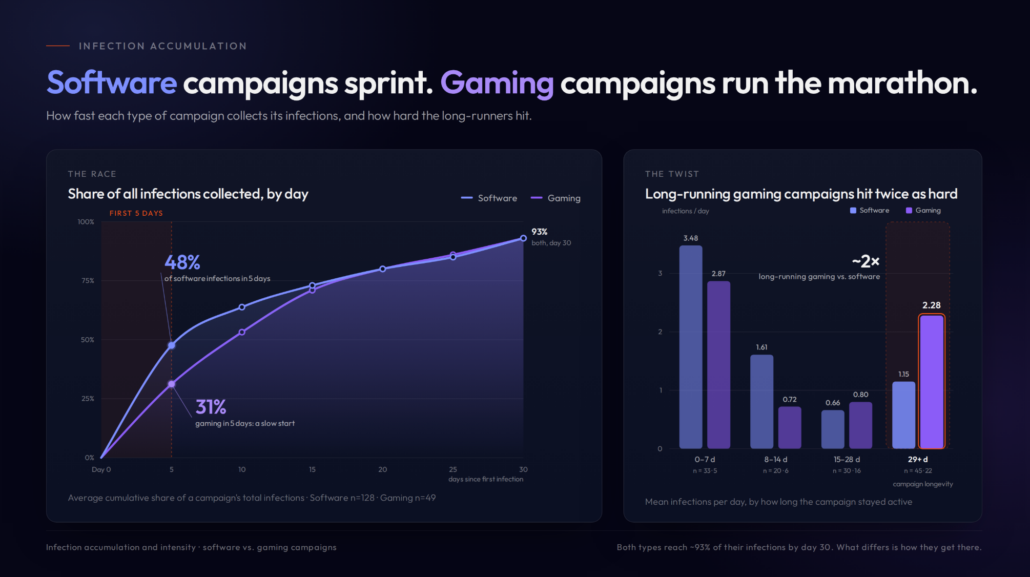
Gaming campaigns take their time, they are marathoners. They start slower, with under a third of their infections (31%) in the first five days. And instead of fading with age like software campaigns, gaming campaigns build momentum. Past the first week, the longer a gaming campaign lives, the more people it infects each day. Those still running past four weeks averaged 2.28 infections a day, about twice the rate of long-running software campaigns. An executor or mod menu keeps circulating on YouTube and Discord, and word of mouth keeps feeding it.
So what does that mean in practice? For software campaigns, speed is everything: you have days, not weeks, to act. For gaming campaigns, the opposite is true. A campaign that’s still around after a few weeks is probably getting stronger. You have to keep watching them for as long as they’re alive.
Where Do They Spread From?
The two ecosystems also spread from different places, and that changes how you fight them.
Gaming campaigns run on a three-step chain. A YouTube video or a Discord server builds hype, then sends people to a website that looks official, often named after the mod/cheat itself (think kiddionsmodmenu.com). From there, a GitHub or MediaFire link delivers the payload. Almost every gaming campaign with links in our data (93%) used one of these lookalike sites.
The lookalike sites are mostly single-use: there were over 200 of them, and most served just one campaign. Taking them down means chasing one site at a time, and new ones pop up just as fast. The real pressure points are the platforms they all share. GitHub showed up in 45% of gaming campaigns, and MediaFire and YouTube in about a third each. Those platforms already have abuse teams, so that’s where one takedown effort can hit many campaigns at once.
Software campaigns lean on the classics of piracy. 40% of software campaigns were distributed through torrent indexes, and The Pirate Bay alone accounted for 27%. Standalone crack sites showed up too, but they were rarely shared between campaigns. Don’t expect to take The Pirate Bay down, though: it was reached through 20 mirror domains. Its value is visibility. Because so many campaigns go through it, watching a handful of torrent sites gives you an early view of a large share of software campaigns.
Recommendation for Security Teams
For practitioners, it’s likely that employees may use company devices to download personal tools and games. Knowing the lures changes what we can tell users. “Don’t download cracks” is advice people already ignore. It sounds like a parent’s spooky tale: download cracked software and the boogeyman will get you. A specific warning lands differently. “The Kiddions mod menu infected over 500 GTA players in under two months” or “the cracked free version of Microsoft Word is likely infostealer malware” names something people might actually be about to download, and puts real victims behind the risk.
From Weakest Link to First Line of Defense
Security loves calling humans the weakest link. For years, the answer has been to pour more money into technical defenses. But as we’ve seen, infostealers don’t break through those defenses, they talk people out of them. No better signature will patch a user switching off their antivirus in two clicks.
What we can do is know the lures. And the good news is that lures are far more stable than the infrastructure behind them. Links get taken down and payloads get repacked, but “Kiddions mod menu” stays “Kiddions mod menu”. Track the lure, and dozens of rotating links and payloads collapse into a single campaign defenders can act on.
Threat actors have always exploited humans when technical exploits fail. It’s the oldest trick in the book, and still the most effective. So let’s flip the script: stop treating users as liabilities, and start building tools that put them back in control.
Want the full methodology, evaluation and failure cases? Read the white paper: Tracking What Works: Social Engineering Lures as Signatures for Victim-Centric Infostealer Campaign Discovery.
Infostealer Exposure Monitoring
Find Out Which Infostealer Lures Are Putting Your Organization at Risk
Infostealers don’t break through your defenses, they talk people out of them. Start a free trial to search stealer logs for infections tied to your employees, customers, and domains, and act before stolen access is used against you.