

By Assaf Morag, Cybersecurity Researcher
Imagine after a long day, you realize you need some cash. On the way home, you stop at a nearby ATM, insert your credit card, and withdraw some money without thinking much of it.
A few days later, your banking app shows some unaccounted purchases you had never seen before. The seemingly ordinary withdrawal has turned into a fraud investigation, and you’re left trying to figure out what happened, how your information was stolen, and whether you’re a skimming operation victim.
Despite decades of awareness campaigns, law enforcement action, and advances in payment security, the underground skimming economy remains active, profitable, and surprisingly well organized.
We analyzed hundreds of underground posts mentioning skimmers and ATM fraud published between January and May 2026, and curated notable threat intelligence about this ecosystem.
Key Findings of ATM Skimming
- Fraud playbooks outnumber hardware sales: Operational methods and cashout narratives accounted for 40.1% of analyzed posts, compared with 14.3% for direct skimmer advertisements, which reflects a ratio of nearly three to one.
- Skimming remains accessible: Complete ATM skimming setups were advertised for as little as $1,000–$2,800, with supporting wireless cameras selling for just $300–$400.
- A handful of threat actors drive most of the noise: While the dataset contained 342 unique actor names, the top five actors accounted for 22.9% of all observed activity.
- The market sells outcomes, not devices: Threat actors increasingly market profits, success rates, and “time-to-cash” rather than technical hardware specifications, transforming ATM fraud into a perceived business opportunity.
- Regional focus: Some criminal advertising suggests threat actors may design and build skimming devices that focus on specific geo-locations.
Underground Fraud Monitoring
See What the Underground Is Selling Before It Hits Your Customers
Skimming playbooks, vendor listings, and cashout guides circulate across Telegram, dark web forums, and carding marketplaces long before fraud reaches your accounts. Start a free trial to monitor these communities and spot threats targeting your brand, banks, and cardholders.
What is ATM Skimming?
ATM skimming commonly combines a device that captures magnetic-stripe track data with a separate means of recording the cardholder’s PIN.
The skimmer may be an external overlay disguised to match the ATM’s card slot or an insert hidden inside the card reader. A concealed pinhole camera or keypad overlay captures the PIN. Together, the stolen track data and PIN can support fraudulent withdrawals using counterfeit magnetic-stripe cards where such transactions are accepted and authorized, but they do not reproduce the original card’s EMV chip functionality. Depending on the design, the devices store the captured information for later retrieval or transmit it wirelessly, often without the victim noticing.
A video that demonstrates what skimmers look like (Source: @thefightdon)
Inside the Skimming Underground
Between January 1 and May 31, 2026, 2,649 posts related to the keyword “skimmer” in underground communities. After removing duplicates and irrelevant results (news stories, industrial machinery listings, etc.), we had 1,027 posts for in-depth analysis and classification.
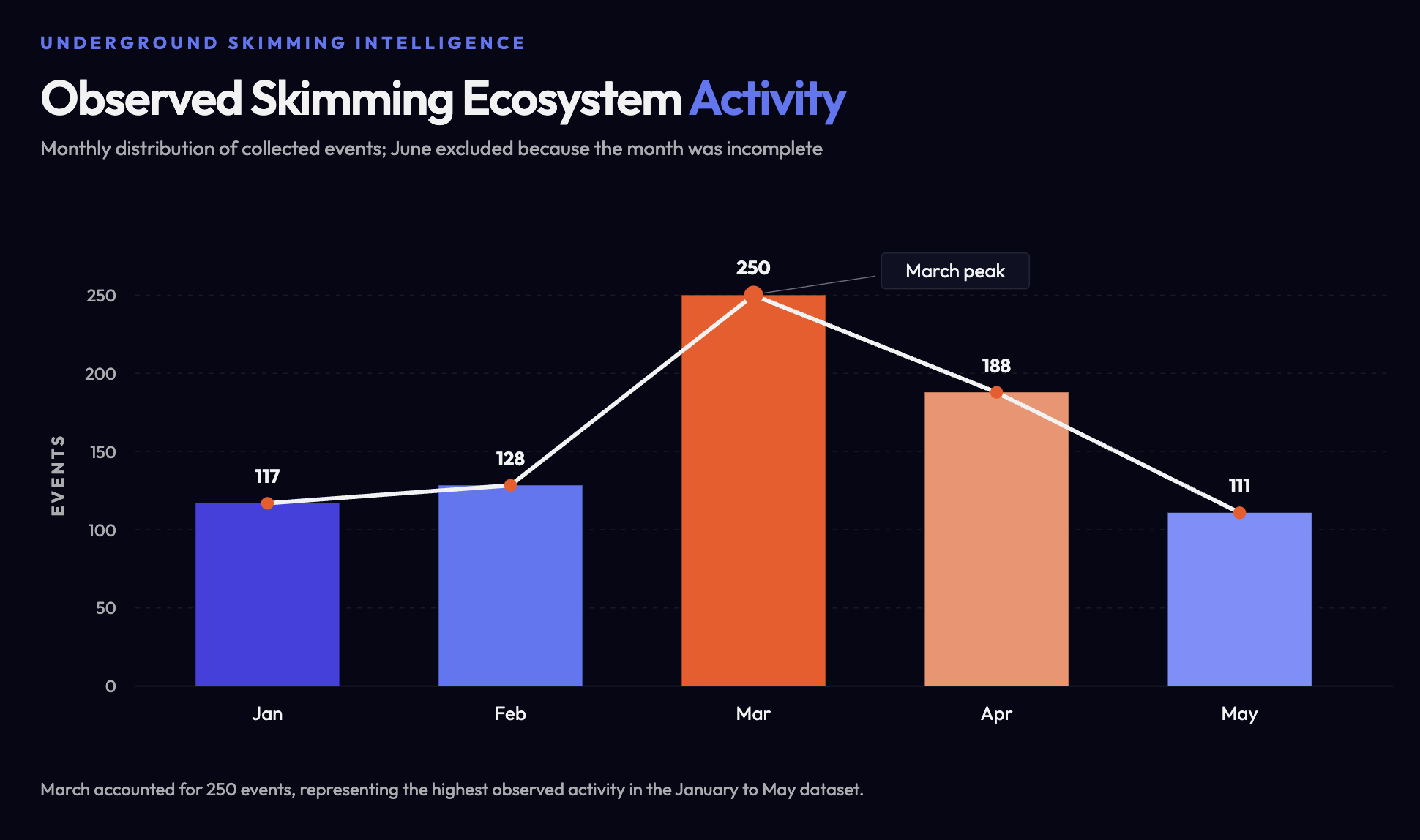
Distribution of skimming posts
More than 40% of the posts were related to operational methods and explanations of how to deploy and work with skimmers.
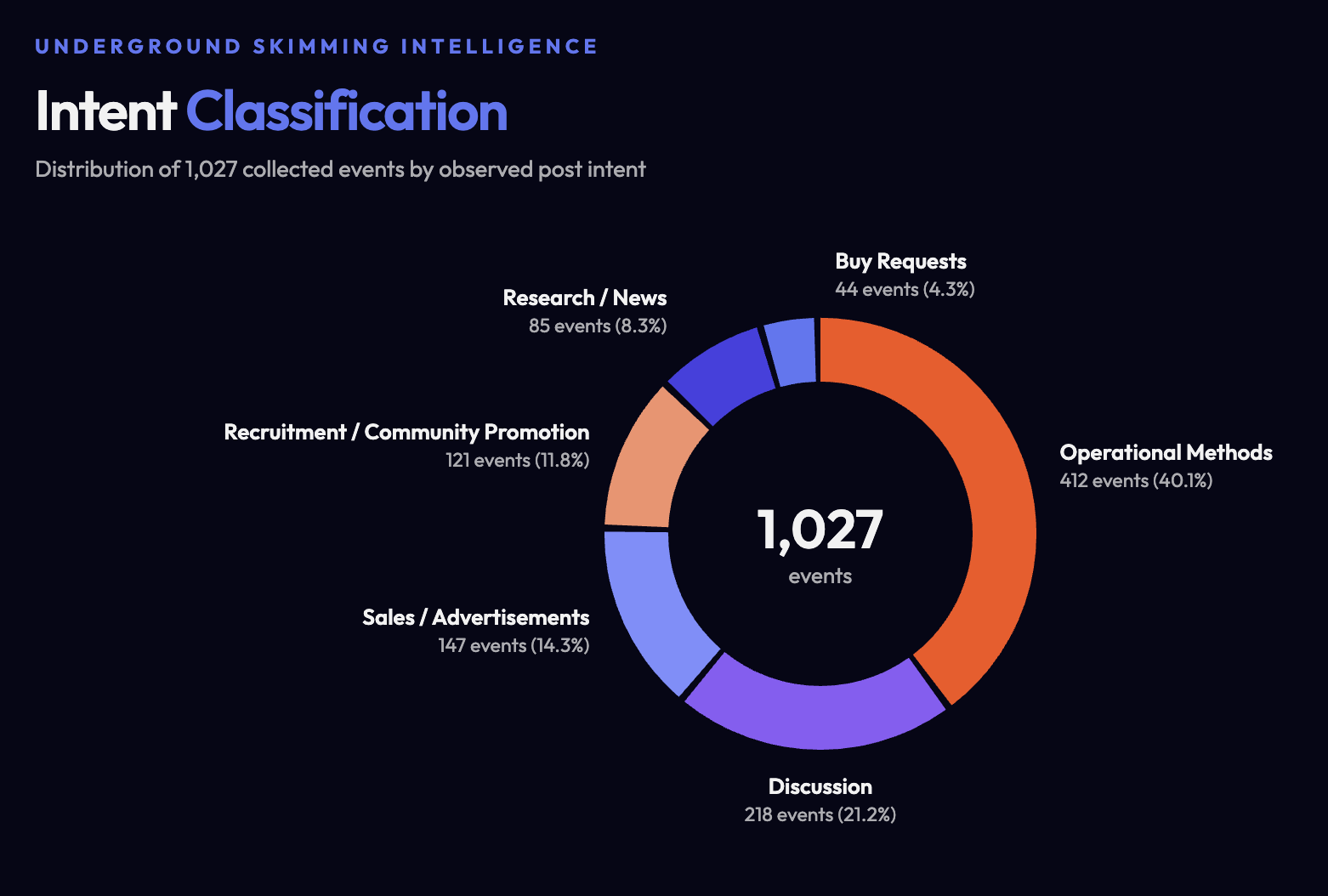
Classification of the nature of these posts
In terms of distribution, most posts appeared on instant messaging platforms (about 37%), primarily Telegram, and on deep and dark web forums (about 36%). The top sources included:
- Legendz Forum
- CryptBB
- Carder Market
- CardVilla
- BreachForums
- Telegraph
- Dread
- CRDPro
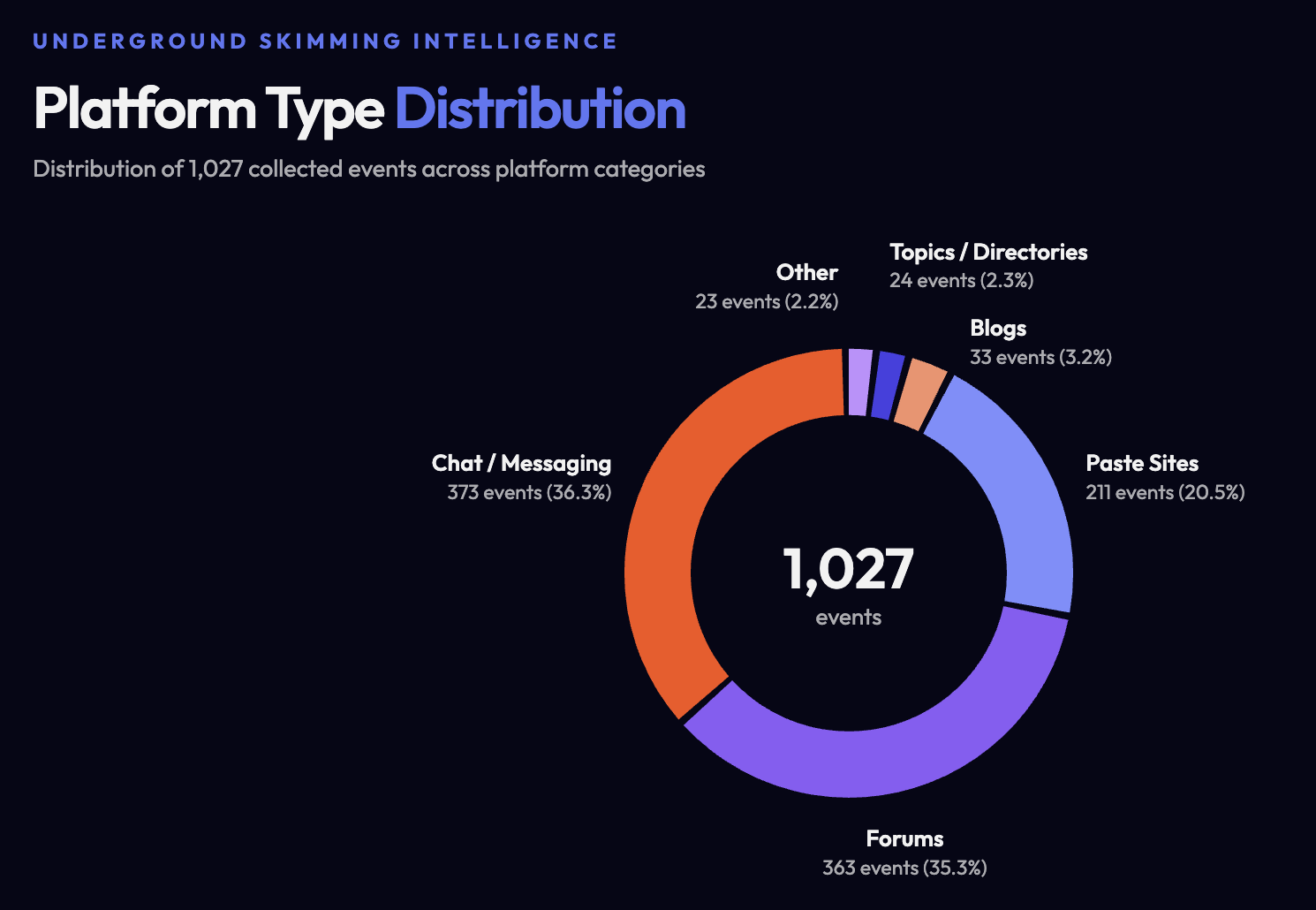
Distribution of platforms breakdown
ATM Fraud Price Lists and Low Barrier to Entry
One of the more surprising findings from the dataset was how affordable specialized skimming equipment has become. Rather than custom-built devices reserved for sophisticated criminal groups, many listings advertised ready-made products at prices comparable to everyday consumer electronics.
Average prices:
- Skimmer: approximately $1,800
- Camera: approximately $330
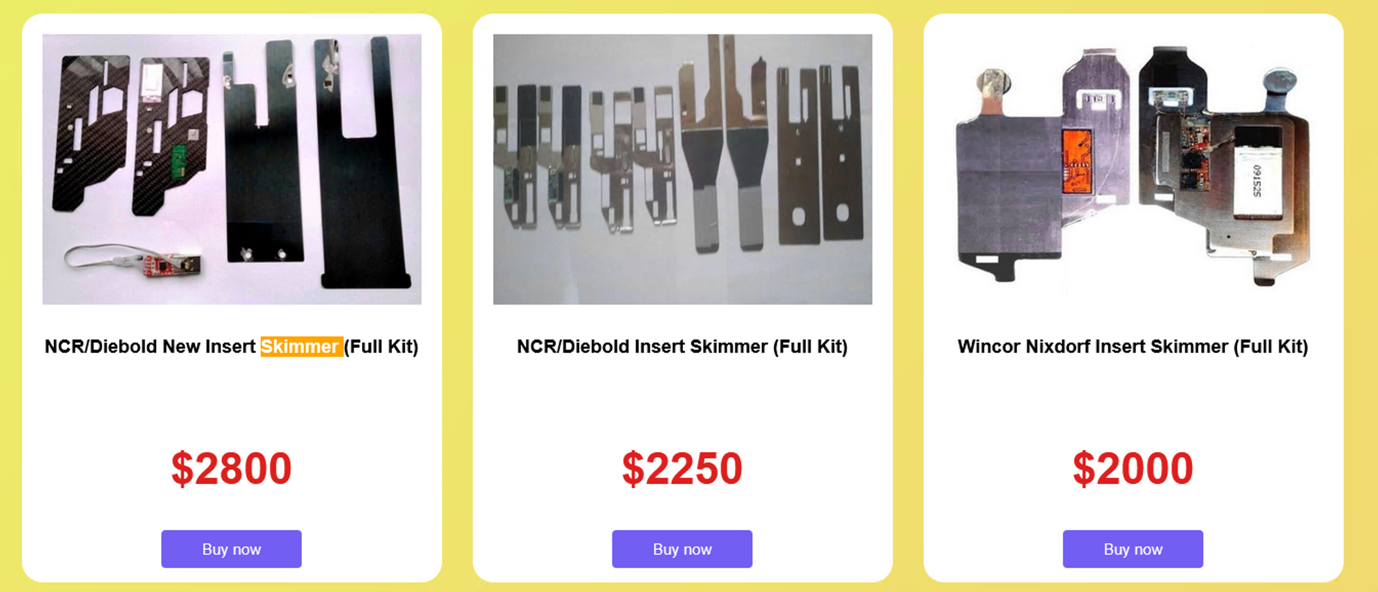
Skimmer equipment sold in a Tor dark web marketplace
Price ranges by tier:
- Premium ATM skimming kits: $2,000–$2,800
- Mid-tier skimming kits: $1,000–$1,500
- Wireless ATM cameras: $300–$400
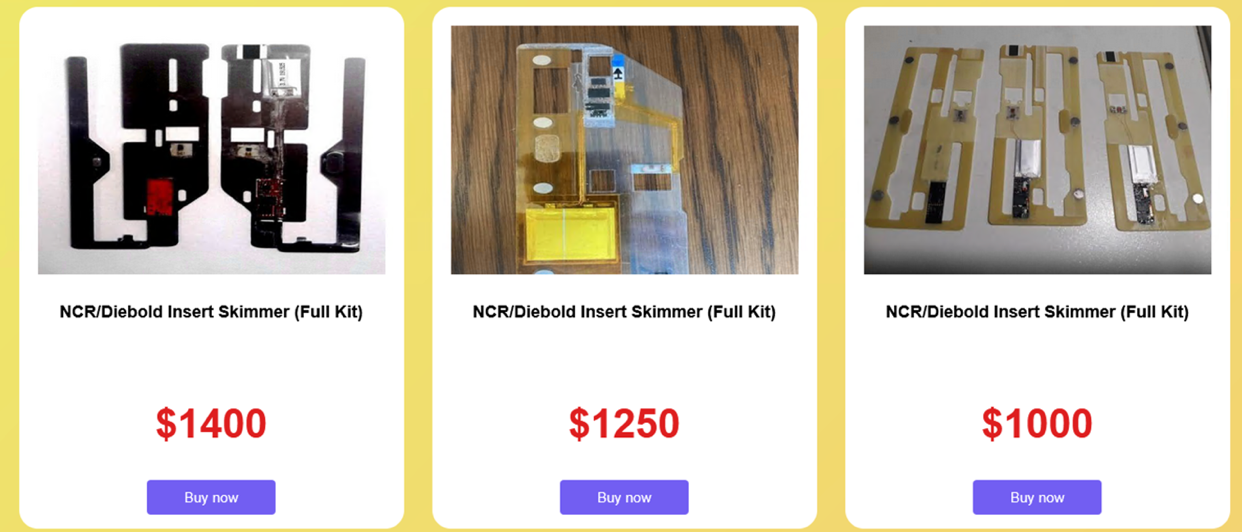
Mid-range skimmer equipment sold in a Tor dark web marketplace
The prices were specific to the ATM manufacturers including:
- NCR
- Diebold
- Wincor Nixdorf
- NCR SelfServ
What stood out was not only the pricing, but also the level of product specialization. Vendors offered multiple hardware generations, premium and budget versions, bundled accessories, and ATM-specific compatibility options. Skimming tutorials are also widely available, meaning a threat actor could launch an effective ATM fraud operation for a couple thousand dollars.
The European Skimmer Campaign (Germany, Austria, and Spain)
Among the recurring fraud narratives identified in the dataset was a templated post targeting customers of major German, Austrian, and Spanish financial institutions. The posts promoted a card-cloning and ATM cashout scheme allegedly focused on Sparkasse customers and claimed that attackers could profit by harvesting payment card information from physical ATMs before conducting fraudulent cash withdrawals.
One notable characteristic was the use of AI-themed branding. The post assigned an “AI Verification Score” to the methodology and promoted an AI-powered assistant alongside Telegram channels and community contacts. However, the threat actors only wrote they have AI capabilities without providing further information or proofs for these capabilities.
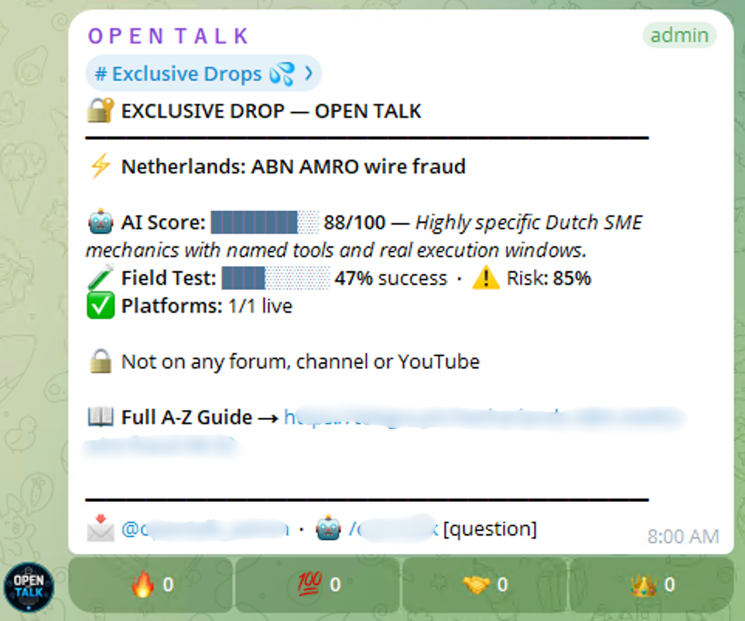
Telegram message about a fraud tool with an “AI Score”
The “OPEN TALK” Telegram community appeared to function as an AI-enabled criminal support hub. Members routinely requested assistance related to payment card fraud, OTP bypass techniques, leaked databases, cryptocurrency scams, spam campaigns, traffic generation, and financial crime. Rather than exchanging detailed expertise among themselves, many users attempted to leverage the group’s AI bot to generate answers, tools, or methods on demand. This suggests that AI is increasingly being positioned as a force multiplier within underground communities, lowering the barrier to entry for less experienced actors seeking guidance on illicit activities.
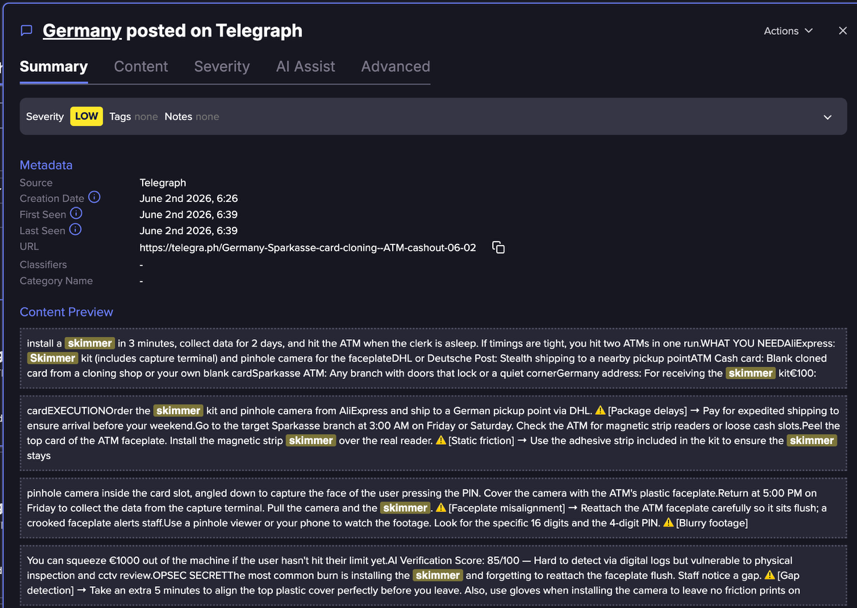
Skimmer operation published by a threat actor (Flare link to post, sign up for the free trial to access if you aren’t already a customer)
Analysis of the 4,368 messages in the OPEN TALK Telegram community revealed that the operators were actively localizing fraud content around specific countries and financial institutions. The most prominent ATM fraud narratives targeted the largest banks in the region including Santander (Spain), Sparkasse (Germany), and Erste Bank (Austria), while promotional material claimed coverage across 20 countries spanning Europe, North America, Asia, the Middle East, and Australia. Rather than publishing generic fraud discussions, the group appeared to package country-specific playbooks around recognizable banking brands, suggesting an effort to increase credibility and engagement among regional audiences. The concentration around large retail banking organizations with extensive ATM networks indicates that financial institutions remain a primary theme in the group’s strategy.
A Small Number of Actors May Be Driving a Large Percentage of the Conversation
Our analysis found extensive reuse of nearly identical templates across multiple countries, banks, and platforms. Posts targeting the large banks frequently followed the same structure, language patterns, formatting conventions, and profitability claims. The only meaningful differences were the bank names, city names, and withdrawal limits.
This pattern suggests that what appears to be hundreds of independent discussions may actually originate from a much smaller group of actors or communities generating content at scale. Rather than uncovering thousands of unique fraud methods, researchers observed evidence of systematic content replication designed to maximize visibility across forums, paste sites, blogs, and messaging platforms. From an intelligence perspective, this indicates that measuring raw post volume alone may overestimate the true number of active threat actors involved in the ecosystem.
Analysis of actor attribution data supports this hypothesis. While the dataset contained 342 unique actor names, a small number of prolific accounts generated a disproportionately large share of the content. The most active account alone was responsible for more than 11% of all observed posts, while the five most active actors collectively accounted for nearly a quarter of the dataset.
This concentration suggests that raw post volume may significantly overstate the number of active participants within the skimming ecosystem and reinforces evidence of content amplification, reposting, and industrialized fraud marketing across multiple platforms.
The Market Is Selling a Lifestyle, Not a Device
One of the most surprising findings was that hardware sales represented only a fraction of the observed activity. Across the dataset, operational playbooks and fraud narratives outnumbered direct skimmer advertisements by more than three to one. Rather than focusing on the technical characteristics of skimming devices, actors spent most of their effort marketing outcomes: how much money could allegedly be earned, how quickly cash could be withdrawn, what banks to target, and how much “risk” was involved.
This suggests that the modern skimming ecosystem is increasingly focused on customer acquisition rather than hardware distribution. The most successful actors are not necessarily those selling skimmers, but those selling the idea that ATM fraud can be transformed into a repeatable business model. Many posts resembled startup marketing materials, complete with profit estimates, operational timelines, onboarding instructions, and support channels. In several cases, the hardware itself appeared almost secondary to the surrounding fraud narrative.
Intelligence Value for Law Enforcement, ATM Manufacturers, and Financial Institutions
Underground marketplaces provide intelligence that can help law enforcement, ATM manufacturers, banks, fraud teams, and payment providers understand evolving criminal demand. Monitoring product offerings, vendor activity, and customer discussions can help these stakeholders:
- Identify platforms attracting criminal interest. Repeated references to particular ATM models, manufacturers, or payment technologies may indicate targeting priorities, although marketplace discussion alone does not establish actual attack frequency.
- Detect emerging fraud trends early. New skimmer designs, surveillance accessories, and fraud techniques may appear in underground communities before investigators encounter them at scale.
- Understand attacker adaptation. Changes in products and marketing claims can reveal how criminals seek to overcome anti-skimming technologies, chip-and-PIN protections, transaction monitoring, and other defensive measures.
- Map criminal supply chains and support attribution. Recurring vendors, distributors, and intermediaries may connect multiple fraud campaigns. Correlating marketplace activity with payment-fraud investigations, carding forums, and other evidence can strengthen these connections.
- Support investigations and security improvements. Product descriptions, photographs, technical claims, and customer discussions can generate investigative leads and help manufacturers and financial institutions prioritize anti-tampering controls, detection capabilities, and product-security roadmaps.
The value extends beyond observing current activity: these marketplaces can reveal what criminals are preparing to attempt next. Their claims should be treated as leads to validate, rather than proof of operational capability or successful exploitation.
What Consumers Should Know About ATM Skimming
Although financial institutions continue to deploy increasingly sophisticated anti-fraud technologies, consumers remain the first line of defense against many skimming attacks.
Most skimming incidents occur without the victim realizing anything unusual happened at the time of the transaction. For this reason, awareness remains one of the most effective protective measures.
Before using an ATM or payment terminal:
- Inspect the card reader for anything unusual, loose, or misaligned.
- Look for suspicious attachments around the keypad area.
- Cover the keypad while entering a PIN.
- Use ATMs located inside bank branches whenever possible.
- Monitor account activity regularly.
- Enable transaction notifications through mobile banking applications.
Warning signs that may indicate compromise include:
- Unauthorized ATM withdrawals.
- Transactions from unfamiliar locations.
- Small test transactions followed by larger withdrawals.
- Card declines despite sufficient funds.
- Notifications from your bank regarding suspicious activity.
What To Do If You Suspect Your Card Was Compromised
Acting quickly can significantly reduce potential losses. If you believe your card information may have been stolen:
- Contact your bank immediately and report the suspected fraud.
- Freeze or block the affected card through your banking application or customer support.
- Review recent transactions for unauthorized activity.
- Request a replacement card and new credentials if necessary.
- Change online banking passwords if account compromise is suspected.
- Document suspicious transactions for fraud investigations.
- Report the incident to local authorities if required by your jurisdiction.
The faster a compromised card is reported, the greater the likelihood that fraudulent transactions can be stopped before additional damage occurs.
While ATM skimming has existed for decades, the underground data analyzed in this report demonstrates that it remains an active and evolving criminal business. Understanding how these ecosystems operate, and knowing how to respond when incidents occur, can help both organizations and consumers reduce their exposure to payment-card fraud.
Further Reading
The FBI states that skimming devices illegally installed on ATMs, POS terminals, or fuel pumps capture card data and may record PINs. It estimates skimming costs consumers and financial institutions over $1 billion annually. The US Secret Service also describes ATM/POS skimming as hidden devices used to record cardholder information.
Additional references:
- What are ATM skimmers & how to spot them (Chase)
- How to spot a credit card skimmer to protect your finances (NBC10 Philadelphia)
- Video shows suspects smoothly install credit card skimmers; Here’s how to protect your money (WXYZ-TV Detroit)
The New Era of Skimming
ATM skimming may be one of the oldest forms of payment-card fraud, but the ecosystem supporting it continues to evolve. Our analysis shows that the underground skimming economy extends far beyond the sale of hidden card readers and wireless cameras. It now includes specialized vendors, AI-branded communities, localized fraud campaigns, reusable operational playbooks, and marketing techniques designed to attract and onboard new participants.
Perhaps the most significant finding is that much of the observed activity was not focused on the hardware itself. Instead, threat actors increasingly marketed outcomes: profit, simplicity, scalability, and perceived success. In many cases, skimming devices appeared almost secondary to the broader narrative being sold. This shift suggests that the underground market is becoming more accessible, more commercialized, and more focused on expanding participation than ever before.
For financial institutions, ATM manufacturers, law enforcement agencies, and fraud investigators, monitoring these communities provides valuable visibility into attacker priorities, emerging fraud techniques, targeted organizations, and evolving criminal business models. Understanding what criminals are discussing today may help defenders identify what they are likely to attempt tomorrow.
Underground Fraud Monitoring
See What the Underground Is Selling Before It Hits Your Customers
Skimming playbooks, vendor listings, and cashout guides circulate across Telegram, dark web forums, and carding marketplaces long before fraud reaches your accounts. Start a free trial to monitor these communities and spot threats targeting your brand, banks, and cardholders.